Pages

Friday, April 13, 2012

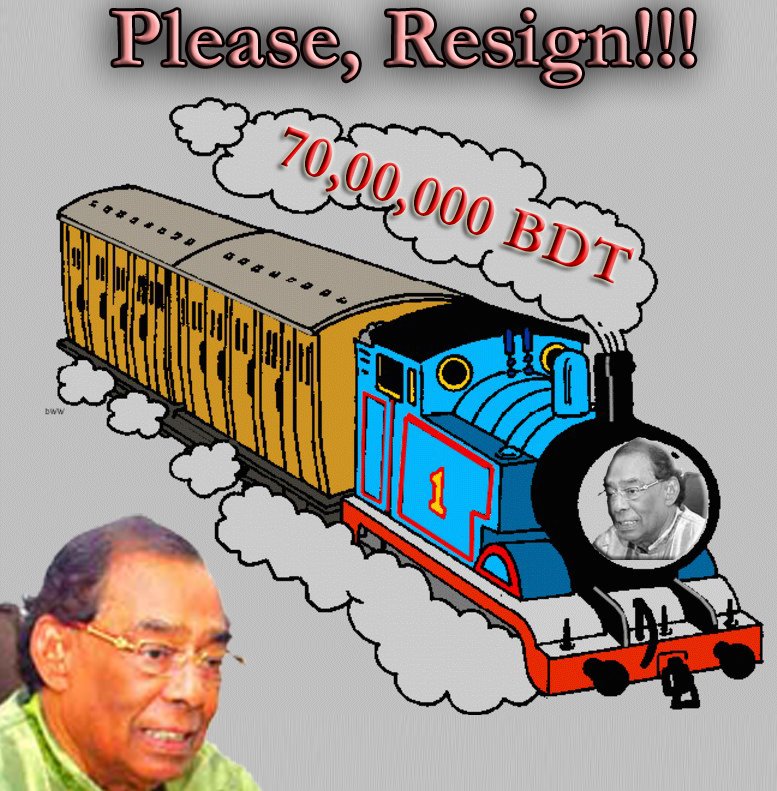
TK 70 LAKH SCANDAL : Suranjit comes under fire

Railway Minister Suranjit Sengupta received heavy condemnation from various quarters over the seizure of Tk 70 lakh from his assistant personal secretary’s car Monday night and the casual manner of his handling of the matter afterwards.

The parliamentary body on railway ministry and officials of railway and other ministries alleged that Suranjit took the matter very lightly. They questioned how neutral the two probe committees, formed by the minister, would be when an officer of the same ministry is to investigate his subordinates.

Even the Anti-Corruption Commission joined the crowd on Wednesday. The graft watchdog said it would launch a probe into the minister’s alleged involvement in the incident, reported Channel i, a private TV channel.

The opposition BNP demanded the minister’s resignation while the parliamentary body launched a probe into the ministry’s handling of tenders over the last three years.

However, the money found in the car is believed to be bribes from railway job seekers.

Suranjit’s APS Omar Faruq Talukder, Railway’s General Manager (East) Yusuf Ali Mridha and Divisional Commandant Enamul Huq were in the car. Driver Ali Azam was driving the vehicle, stopped on the way to Suranjit’s Jogatola house, and entered into the Border Guard Bangladesh (BGB) headquarters at Dhanmondi in the capital around 11:30pm Monday. Ali Azam drove the vehicle into the Border Guard Bangladesh (BGB) headquarters in the capital and exposed the bribe money. The border guards discovered the money in the car and detained the four.

When guards at the gate rushed towards the vehicle as it had entered the BGB headquarters without authorisation, the driver told them there was bribe money stashed in the car. The guards discovered Tk 70 lakh in the car and they detained the four.

One Bangla daily has reported that Omar Faruq Talukder has amassed enormous wealth in three years.

Charge of corruption
 At the very maiden meeting of the Parliamentary Standing Committee on the Railway Ministry, Minister Suranjit Sengupta faced the charge of corruption from the opposition BNP.

Rehana Akter Ranu, the lone opposition member on the committee, rejected the ministry’s probe body formed to investigate the alleged capture of Omar Faruk Talukder, assistant personal secretary (APS) of Suranjit, with Tk 70 lakh. She told reporters that Omar earned the money from the ‘recruitment trade’ and the sum was supposed to go to the minister.

Railway Minister inspires seven cartoonists
Thursday was in no way designated for any local, national or international event relating to satirical cartoon.
But in a unique coincidence in Bangladesh media, seven leading  national dailies on April 13 preferred to publish front page cartoons on Railway Minister Suranjit Sen Gupta along side reports, editorials and commentaries about the recovery of huge corruption money from the car of Sen Gupta’s APS.

The veteran politician who was made Railway Minister a few months ago, received a volley of criticism calling for a resignation from various quarters following the seizure of Tk 70 lakh ( about 90,000 US dollars) from the car of his APS around 11:30pm Monday and Suranjit’s handling of the matter afterwards.

The BGB personnel sought police help but police refused to take the responsibility, saying there was no case filed against them. Faruq, Yusuf and Enamul were eventually released but the driver is said to be still in BGB custody.

Meanwhile, the opposition BNP demanded the minister’s resignation, while the parliamentary standing committee launched a probe into the ministry’s handling of tenders over the last three years.

ACC to probe
As the critical public reactions spread quickly against the minister, the Anti-Corruption Commission (ACC) announced on Tuesday that it would launch a probe into the minister’s alleged involvement in the incident.
Highly embarrassed by the incident, the ruling party leaders are now waiting for the prime minister to return from Turkey and tell them what to do about the scandal.

Suranjit, clearly on the back foot, termed the incident unwarranted adding, “In a country like ours, this kind of incidents has happened before. This incident has created problems for me. I will face it.”

Bribes from job seekers
Sources in the railway said ruling party people in the leadership of railway employees, ministers, lawmakers, and a section of corrupt railway officials were taking bribes from job seekers. The railway ministry recently started recruitment of 7,500 people.

According, railway officials Tk 2 lakh to 5 lakh was taken from each jobseeker assuring job in railway.

Judicial probe demanded
Opposition member of the parliament (MP) Rehana Akhter Ranu, who is also a member of the parliamentary standing committee on railway Minister, demanded that the government constitute a judicial probe body to investigate the source and destination of the money found in APS possession. She said Suranjit must resign for the sake of an impartial investigation.

 “We believe the minister’s APS and a general manager of railway were taking the money to him [Suranjit], which was bribe in exchange for jobs in the ministry.” Rehana Akhter MP said,

Awami League Deputy Office Secretary Mrinal Kanti Das, however, said there might be a conspiracy behind the incident. It could have been staged to disgrace the government.

But newspaper readers’ comments and public reactions suggest that Suranjit Sengupta should take full responsibility of the incident and resign when someone so close to him and a high-ranking railway officer are involved in such a huge bribery scam.

“Even a grade three student would realise and understand that you cannot investigate against yourself. Sengupta must resign and independent and credible investigation must be conducted. If we fail to set 

standards here we have very little chance to get out of the stigma of being the number one corrupt nation,” commented an online reader.

BY :   Abdur Rahman Kha.

Wednesday, April 11, 2012

We were on way to minister's residence ; Says railway security official

Two top railway officials, Railway Minister Suranjit Sengupta's assistant personal secretary (APS) and his driver along with Tk 70 lakh were going to the minister's Jigatola residence on Monday night, intelligence sources told The Daily Star yesterday. 

The minister, however, refuted the claim.

Railway's Dhaka division Security Commandant Enamul Huq, one of the four persons who were detained by the Border Guard Bangladesh (BGB) personnel at Pilkhana with the money, claimed yesterday that he had no idea that they were going to the minister's house.

The other top railway official is Yusuf Ali Mridha, railway general manager (East) while the railway minister's APS is Omar Faruq Talukder.

"I came to know about the money when microbus driver Ali Azam drove into the Pilkhana headquarters around 11:30pm, screaming that there was illegal money in the vehicle," he told The Daily Star at his office yesterday.

Sources say the driver might have created the scene as he was refused Tk 5 lakh as a share of the amount.
After the scandal came to light on Tuesday, Suranjit told reporters he was ignorant of the movement of the four detained persons, saying he was not supposed to know their whereabouts after office hours.

The Daily Star tried to talk to the four persons, but could reach only Enamul Huq at his Kamalapur Railway Station office. 

Yusuf Ali Mridha was neither found at his Railway Officers' Staff Quarters residence nor did he receive calls despite repeated attempts. 

The cell phones of the minister's APS and his driver were also found switched off.

Maj Gen Anwar Hossain, BGB director general, on Tuesday told The Daily Star that his force freed all the four detainees.

But Enamul Huq yesterday said the BGB men still had driver Ali Azam in their custody.

"As the driver was not released, another person called by the minister's APS drove us out of the border guard headquarters," he told The Daily Star.

This paper has also made repeated attempts to contact a number of BGB officials to verify Enamul's statement but none of the border official took any call.

ENAMUL HUQ'S VERSION:
According to Enamul, he got involved in the incident as Yusuf Ali Mridha asked him to go to the minister's house that night.

"First, we reached a house at Dhanmondi-3 by the car of the general manager [Yusuf Ali]. I waited in the car as the GM entered the house. About an hour later, the GM and the APS [Omar Faruq] came down and asked me to leave the car and get into the microbus of the APS," said Enamul.

"When we reached near Pilkhana around 11:30pm, the driver drove the vehicle into the Pilkhana BGB headquarters through gate No 4."

"At one stage, the driver asked the BGB men to detain the GM and the APS, as he screamed there was illegal money," Enamul said.

"At this, Omar Faruq told the driver and the BGB men that there was no illegal money and that it was his money. He [Faruk] said his relatives gave him the money for business and for his sister's marriage," Enamul added. 

Following arguments for around 40 minutes, some BGB personnel approached the microbus and took the keys.

"The BGB men kept us in a room in the Pilkhana [on Monday night] and on Tuesday they freed three of us after verifying our identities but kept the driver detained," he said. 

Replying to a query, Enamul said none intercepted them to know their identities when the driver drove the microbus into Pilkhana.

It may be mentioned that the BGB headquarters is heavily guarded and it is quite impossible for outsiders to enter it without the BGB members checking their identities.


'Railway-gate' Scandal Suranjit comes under fire

Govt embarrassed; BNP asks minister to go; ACC to probe; Tk 70 lakh alleged to have come from recent recruitment.


Railway Minister Suranjit Sengupta received heavy flak from various quarters over the seizure of Tk 70 lakh from his assistant personal secretary's car Monday night and his handling of the matter afterwards. 

The parliamentary body on railway ministry and officials of railway and other ministries alleged that Suranjit took the matter very lightly. They questioned how neutral the two probe committees, formed by the minister, would be when an officer of the same ministry would be investigating his subordinates. 

Even the Anti-Corruption Commission joined the bandwagon yesterday. The watchdog said it would launch a probe into the minister's alleged involvement in the incident, reports Channel i, a private TV channel. 

Meanwhile, the opposition BNP demanded the minister's resignation while the parliamentary body launched a probe into the ministry's handling of tenders over the last three years. 

The money found in the car is believed to be bribes from railway job seekers.

On late Monday, Ali Azam, driver of Suranjit's assistant personal secretary Omar Faruq Talukder's car; with him, Railway's General Manager (East) Yusuf Ali Mridha and Chief Commandant Enamul Huq on board drove the car into the Border Guard Bangladesh (BGB) headquarters in Pilkhana in the capital. When guards at the gate rushed to the vehicle for unauthorised entry, the driver told them there was bribe money stashed in the car. The guards discovered Tk 70 lakh in the car and they detained the four. 

adesh (BGB) headquarters in Pilkhana in the capital. When guards at the gate rushed to the vehicle for unauthorised entry, the driver told them there was bribe money stashed in the car. The guards discovered Tk 70 lakh in the car and they detained the four. 

The BGB personnel wanted to hand them over to police but police refused to receive them saying there was no case filed against them. Faruq, Yusuf and Enamul were eventually released but the driver is said to be still in BGB custody.

The Daily Star failed to reach the driver for comments despite repeated attempts on his two mobile phones. 

BNP acting secretary general Mirza Fakhrul Islam Alamgir during a demonstration in the capital against price hike of essentials called for Suranjit's resignation. He said the minister should shoulder the responsibilities of what has happened, reported UNB. 

Suranjit, clearly on the back foot, held a press conference yesterday and said Faruq and Yusuf had been asked not to come to work until further notice. 

“This was unwarranted,” Suranjit Sen Gupta told the press, adding, “In a country like ours, this kind of incidents has happened before. This incident has created problems for me. I will face it.”

When the press asked if he had suspended them, he was rather vague and said, “You can also think like that if you want.”

However, after the seizure of the money the minister had told a press briefing at Rail Bhaban that the two would continue work since they have not been proved guilty of any wrongdoing. He denied that Enamul was even in the car.

Late last night, Suranjit's personal secretary sent a letter to the secretary of the ministry informing him of Faruq's suspension from yesterday morning. 

Sources in the railway said Rail Sramik League, ministers, lawmakers, ruling party leaders and a section of corrupt railway officials were taking bribes from job seekers. The railway ministry recently started recruitment of 7,500 people.

A senior railway official on condition of anonymity said, “Tk 2 lakh to 5 lakh is being taken from each candidate.” 

During the meeting of the parliamentary body on the railway ministry at the Jatiya Sangsad Bhaban yesterday, a number of lawmakers came down heavily on the minister over the issue. 

They even questioned how an APS has a lawmaker's sticker on his personal car.

The parliamentary body yesterday formed a five-member sub-committee headed by lawmaker Shah Alam to probe alleged irregularities in awarding tender under the ministry's various projects in the last three years.

BNP MP Rehana Akhter Ranu, a member of the parliamentary body, demanded that the government forms a judicial probe committee for this. She said Suranjit must resign for the sake of impartial investigation. 

Rehana said, “We believe the minister's APS and a general manager of the ministry were carrying the money to give him [Suranjit] as bribe in exchange for recruitments in the ministry.” 

Other members, including a ruling party lawmaker, of the standing committee asked the minister about the alleged corruption in recruiting employees in the railway ministry. 

Suranjit, also a member of the parliamentary body, said such incident was unexpected and he would place the enquiry reports of the two probe committees before the parliamentary body and take actions as per the committee's directives. 

Suranjit refused Rehana's demand for judicial probe.

Talking to The Daily Star, several railway officials and employees said the three--Faruk, Mirdha and Enamul--should have been suspended immediately and an independent investigation body should have been formed.
Joint secretary (administration) of the railway ministry Shashi Bhushan Singha was assigned to investigate the involvement of Mirdha while minister's Personal Secretary Akhtaruzzaman was probing the involvement of Faruk.

“How can the minister's PS be assigned to investigate such an incident since both work closely?” a mid-level official told The Daily Star at Railway Bhaban yesterday. He said an official of the ministry could not probe irregularities of an official of the same ministry.

Another junior official said he suspected that proper investigation would not be possible by the probe committees. “Officials of other ministries could have easily been engaged in the probe,” he said, requesting anonymity.

Another official said, “There are allegations that many of us are chor [thieves]. This is the proof of that.”
The official said if Yusuf was quizzed, everything would be revealed.

Meanwhile, the Railway Bhaban yesterday looked desert since morning as almost no senior officials attended work. 

GOVT, AL EMBARRASSED
The government and the ruling Awami League were embarrassed by the incident, The Daily Star found out after talking to several leaders and ministers. 

However, none agreed to make official comments.

“It is really embarrassing for the government and the party as well at this time [late part of the government's tenure],” said a minister requesting not to be named. “It is a very sensitive matter…”

The minister said they would discuss the matter with the prime minister upon her return from Turkey on Saturday. 

Highly placed government sources said that before her departure, the prime minister has asked the railways minister to suspend his APS immediately.

Awami League Deputy Office Secretary Mrinal Kanti Das, however, said there might be a conspiracy behind the incident. It could have been staged to disgrace the government.

ACC TO PROBE
Anti-Corruption Commission Chairman Ghulam Rahman yesterday said the commission would investigate the allegation of bribe against Railways Minister Suranjit Sengupta.

“There used to be no investigation into any allegation against ministers in the past, but now the graft watchdog will probe,” he said, addressing the concluding ceremony of a training programme for the newly-appointed 28 ACC Assistant Directors, reports UNB.

The ACC chairman also said the commission would also conduct an investigation into the allegations of corruption in the Padma bridge project and against the company Destiny 2000.

Saturday, April 7, 2012

India dumping Nuclear waste In Bangladesh

Power failure is now a regular phenomenon in Bangladesh, where the ruling party made specific pre-electoral pledges to the voters of greatly resolving the crisis within the first two years of being in the office. But, reality speaks something else! The current government of Bangladesh Awami League, which leads coalitions of Islamists, leftists and former dictators has greatly failed in addressing large number of national issues, including controlling the prices of essentials, maintaining the law and order situation, getting proper share of water in various rivers from India, stopping campus violence (which are mostly committed by the members of the student front of the ruling party), ensuring rights of the religious minorities, combating terrorism, rape, murder and extortion (again mostly committed by the members of the ruling party) etc.

In brief, this is a worst form of failed governance by Bangladesh Awami League since the creation of the country in 1971. While lives of people have already fallen into the ditch of severe sufferings due to series of adversities, the ruling party, instead of making genuine attempts of resolving the same as rather seen engaged in making fun of people’s agonies as well as continuing limitless looting of public wealth by letting bunch of pro-ruling party looters robbing off billions of dollars from the national exchequer by installing questioned projects such as rental-power stations as well as making false billings from the private owned power plants in the country. At the same time, instead of endorsing people’s sufferings and giving any specific description of government steps in resolving the power crisis, the Prime Minister is making mockery and joke with the entire nation right inside the National Parliament, where she said, load shedding were continuing in the country to remind people about the shortage of power.

Members of the cabinet as well as talkative figures in the ruling party are equally engaged in giving irritating statements possibly with the mission of hiding the huge failures of Bangladesh Awami League in resolving the power crisis, which not only causes acute sufferings to the citizen of Bangladesh, but also are already putting country’s industrial sectors into mere devastation. Foreign investors are no more eyeing on Bangladesh due to two major reasons – one of which is acute power crisis, while next is a total lawlessness in Bangladesh. Members of the youth and student fronts of the Bangladesh Awami League are continuing various forms of illegal activities in such open manner as if they are licensed to commit crime. Law enforcing agencies are either afraid or shy in taking any steps against such notoriety of the ruling party inmates, as any such actions by the law enforcing agencies would only invite dire consequences in his/her service life.

Nuke power and hazards for the civilians
As a bid to resolve the existing acute power crisis in Bangladesh, the ruling party has signed an agreement with Russian Federation for establishment of 2000 mega watt nuclear-based power plant in the country. Experts feel, there are several risks associated with nuclear power plants. The most serious is the question of nuclear waste. Using nuclear power generates radioactive waste which will be radioactive for thousands and thousands of years. Storing such wastes in such safest method, where humans and plants will not be affected is the biggest challenge, because such wastes cause dangerous radiation.

The storage of the waste is an extremely difficult problem to solve, both on a technological and scientific level, but also on a political level. Currently, all the nuclear waste generated by humans on earth is stored in temporary sites. This temporary solution will not be acceptable in the long term. The other major effect of nuclear reactors on the environment is that they need water to cool them. They are often built near a river for this reason. Because the water is used to cool them, that means the water is being heated by the plant. This can raise the average temperature of the water in the river. Changing the temperature of the water can have a very serious and detrimental effect on fish and other organisms living in the river.

India dumping nuclear waste in Bangladesh
India now envisages increasing the contribution of nuclear power to overall electricity generation capacity from 2.8% to 9% within 25 years. By 2017, India’s installed nuclear power generation capacity will increase to 10,080 MW. As of 2009, India stands 9th in the world in terms of number of operational nuclear power reactors. Indigenous atomic reactors include TAPS-3, and -4, both of which are 540 MW reactors. India’s US$ 717 million fast breeder reactor project is expected to be operational by 2012-13.

Each year thousands of tons of nuclear wastes are released from the nuclear power plants, dumping of which is one of the biggest challenges. Since 2001, India has started exporting its nuclear wastes by mixing the same with ash from the thermal power stations. Bangladeshi cement manufacturers alone imports more than five hundred thousand tons of fly ash from India and produces fly ash mixed cement.

The whole concept was first initiated by a company named Holcim, which later successfully infected the idea into the brains of other cement manufacturers in Bangladesh. Through such notorious steps of Holcim and subsequently by other cement manufacturers in Bangladesh, most of the newly constructed domestic and commercial buildings in the country are now becoming slightly or significantly polluted with nuclear contamination, which not only poses huge threat to human lives but also puts substantial threat to the very environment of the country. India also is exporting its nuclear wastes to some other neighboring nations as well as countries in the African continent as well as in the Middle East either by mixing with thermal-power plant generated ashes or with other chemical compounds.

Energy price increase crossed all past records
During the three plus years of rule of the Bangladesh Awami League led leftist, Islamist and former autocrat coalitions government, the increase of fuel as well as energy in Bangladesh has crossed all previous records, while there even had been multiple increases simply within the span of a month. The rulers are trying to convince people stating such increase were necessary to cope with the increase in prices of fuel in the international market, it is clearly understood that such increases were necessary to cope with the huge pressure on country’s economy as well as foreign currency reserve as billions of dollars are rather wasted on feeding the quick-rental power plants as well as those power companies, who are making fortune by virtually robbing such public money through false billings in connivance with some corrupt officials as well as unscrupulous political figures.

Due to such mad increase in prices of fuel and energy, cost of living has greatly increased in Bangladesh, though income never increased in comparing to the degree of such exorbitant increase in the prices of fuel and energy. At the same time, country’s economy is also under huge pressure due to decrease in foreign currency earning as labor market for Bangladeshi workers is shrinking fast, again due to inefficiency of the ministry and departments concerned. There had not been any mentionable foreign investment in the country for past five plus years, as political instability, power crisis, terrorism and massive corruption stood as barriers, where foreign investors are no more considering Bangladesh as a potential ground for their investments.

Though the only good news of these series of bad news is, Bangladesh may now become important ground for many petroleum exploration companies in the world, after the recent resolution of maritime boundary dispute with Myanmar, though many feel that the real result would only be possible if Bangladesh could also settle the dispute with India. The ruling party in Bangladesh is trying their best in portraying the recent resolution of maritime boundary with Myanmar as Sea Victory, which political analysts see as mere political stunt of Bangladesh Awami League, which is badly suffering from series of its failures only during past three past years.

Freedom of media and expression
For the current government in Dhaka, media and public opinion has already become its worst enemies, as the real picture of the failures of the ruling party is clearly portrayed in the media as well as public opinions. The ruling party is trying to apply numerous tricks and policies in somehow suffocating the freedom of expression and rights of the civilians. Opposition parties are regularly obstructed from even peaceful demonstrations against the ruling party and well-planned repressive pogroms are continuing on the political opponents as well as different opinions of the ruling elites in Bangladesh.

Risk of mass revolt
Whenever there is huge repression on civilians as well as attempts of suffocating the freedom of expression and media in any of the nations in the world, there surely is the possibility of outbreak of mass revolt, even in some cases, led by some individual or group, not representing the so-called mainstream parties or groups. In Bangladesh, power crisis is causing huge anger in the minds of the mass people, which is certainly an alarming sign for the rulers.

Currently the average daily load shedding in the rural and urban areas are between 10 to 18 hours. There are indications that such timing may even increase during the month of May and September. Especially the months of May, June, July and August are the hottest summer days in Bangladesh. Political opponents of the ruling party have already picked up the issue of power crisis at the top of their anti-government agendas, which surely is a hugely alarming sign for Bangladesh Awami League. According to political analysts, power crisis is directly affecting the lives of the civilians, where they would voluntarily react and even revolt, if they are given lead by any individual or organization. The analysts also say that the ruling party may use state machinery, law enforcing agencies as well as armed cadres of their youth and student fronts in confronting any such mass revolt, but ultimately it may push the entire nation towards a destination unknown.

According to the analysts, people are already fed up with the increasing sufferings due to load shedding as well as ruthless statements of the ruling elites. Their hidden anger may spark at any time and turn into a huge political inferno for the Bangladesh Awami League. In face of such political eruptions, it will be almost impossible for the ruling party in tackling the situation.

Understanding such political advantageous point, the main opposition Bangladesh Nationalist Party, Bangladesh Jamaat-e-Islami as well as minor parties such as Bikalpa Dhara Bangladesh, Khelafat Majlish, Islamic Unity Front, Bangladesh Khelafat Andolan, Bangladesh Jatiyo Party, Islami Oikya Jote, Gono Forum, Bangladesh Kalyan Party, Liberal Democratic Party, Islami Movement Bangladesh, Jatiyo Gonotantrik Party etc have already started bringing the power crisis and load shedding as well as increase in the prices of fuel at top of their political agendas.

It is anticipated by the political pundits that, much ahead of June 12 political deadline set by Begum Khaleda Zia, former Prime Minister and leader of Bangladesh Nationalist Party, political mercury in the country may touch alarming level or even may give birth to any sudden spark in civilian unrest or mass revolt. Sensing this, Bangladesh Nationalist Party is also re-fixing its political strategies against the ruling party and are believed to be planning to begin massive campaign in the country, protesting Bangladesh Awami League led government’s failures in addressing this important problem, which understandably is aimed at mobilizing millions of people towards the June 12 hard line programs of the main opposition party and its alliance partners.

There is no doubt the ruling party will also apply its all out forces in confronting the political programs of the opposition. And of course, if such confrontation will be similar as the past, there is sufficient room to fear any uncertainty in the country, which may not be any good news for the democracy itself.

Yunus Victim or Villain of Bangladesh Government

Poverty is a curse, which existed from times immemorial and the noble efforts of the Nobles of the Human Race to eradicate it, has never stopped, either; But unfortunately poverty has become the part and parcel of Human Race and is there to stay thriving, no matter what the Humans do to eradicate it.

Poverty is cruel and makes its own history at its own timing and choosing. Dr. Yunus, the founder of Grameen Bank, the Noble prize winning anti-poverty crusader, became its latest victim last year, when the Bangladesh Government decided to remove him from the helm of the largest poverty alleviation bank in the World – Grameen Bank. Litigation was launched against his removal in the courts, but the battle was legally lost. The Political leadership at the highest levels of the Government of Bangladesh is somehow averse to the idea of Dr. Yunus performing any role in Grameen Bank and its sister organizations.

The battle between Dr. Yunus and the government of Bangladesh does not end there; rather it is still ongoing and is being fought in different capitals of the World. Bangladesh government tried unsuccessfully to convince the International supporters of Dr. Yunus to shed their support for him. Domestically the conflict and the news surfaced, when, 9 newly elected Directors of Grameen Bank Board, representing 75 percent shareholders of the Bank, in their first Board Meeting on March 19, 2012, unanimously recommended, that Dr. Yunus should lead the search committee for the New Managing Director of the bank.

It is reported, that the outgoing 9 members of the Board of Directors of Grameen Bank, who left office in January 2012, after completing their three-year tenure, in their 93rd Board Meeting on July 26, 2011 also recommended to include Dr. Yunus, as the chair of the new search committee for the Managing Director. But Khondaker Muzammel Huq, Chairman of the Board, has reportedly said, that there is no scope to make Dr. Yunus the head of the search committee, in the light of the Supreme Court verdict, which said the Dr. Yunus continued in the office of the Managing Director of Grameen Bank, unlawfully for more than 10 years.

The issue came to fore again, as per The Daily Star of April 4, 2012, after a sudden burst from the Finance Minister AMA Muhith, highlighting the government position of not making Dr. Yunus the chief of the selection committee, although the Grameen Bank Ordinance 1983, that governs the microfinance organization, empowers the Board to form such Committee.

Dr. Yunus has done proud to the country by winning the Noble Prize, not the first Bengali, but the First Bangladeshi to do so. He has many achievements to his credit, but he is human and to err is human, therefore it is normal, that he made a few mistakes down the road also. Dr. Yunus enjoys tremendous respect in different capitals of the World irrespective of which school of thought is in power in those countries. He has been welcomed in many a parliament and elected chambers of the different countries of the World and honored with plaudits. Americans and Europeans in particular and numerous other countries and world leaders speak almost in one voice in his support in respect of Grameen Bank complexities and in support of his various noble initiatives and projects worldwide.

Dr. Yunus is a man who cannot be written off or belittled by the efforts of a few elected politicians, whose tenure last till the next verdict of the eligible voters. Dr. Yunus wants to make "poverty history", but in turn poverty is giving him the opportunity to make history out of himself and his contributions to the eradication of poverty. Bravo Dr. Yunus. He has been elected/selected to the noble heights and is supposed to stay there forever irrespective of what the Bangladesh political elite want or dictate.

He made the uncanny mistake of venturing into the uncharted and choppy sea of Bangladeshi politics immediately after winning the Noble Prize. It is reported, that it was not his decision, rather the miffed third forces comprising a section of the intellectuals and civil society elites convinced him, that his newly earned noble capital had the powers to topple the two clan political system in Bangladesh. It was a mistake, well made as Dr. Yunus himself confessed, using a famous Bengali line later, that the "balds don't go under the wood-apple tree the second time". Besides, the utterings of Dr. Yunus on many occasions later confirmed his non-political desires. The political hierarchy of the ruling Awami League is not the least inclined to accept his defenses.

Another joke making rounds in Bangladesh is that the Noble Peace Prize is something that can be bought or earned through maneuverings and can be had by the political heavyweights with family lineage and peace and progress related achievements. The history of Noble Peace Prize winning candidates doesn't go to prove the above "joke", rather it is given to people with outstanding contributions towards the establishment and winning of peace through singular or multilateral approach.

This peaceful looking battle with the Noble Peace Laureate is not going to take the Bangladeshi government anywhere, rather it is hurting the country in manners and means unimaginable. Bangladesh government should have used Dr. Yunus as a bargaining chip with the international community, especially the American and European supporters of Dr. Yunus in winning concessions for the country and furthering the political cause of the government in power. There is still time for the government to realize the consequences of hurting the international sentiments, which initially looked favorably to its rise to political power again in Bangladesh after the 1/11 debacle.

Peace is a process which needs to be initiated from any platform or sector, and the sole purpose should be to promote peace among mankind as a whole, without any pride and prejudice. This writer and WeeklyBlitz thinks, that it is time for the Political elites of Awami League to make peace with Dr. Yunus. Making peace with Dr. Yunus will definitely earn the government the desired credits towards noble achievements of earning the future Nobles for Bangladesh.

Whatever Bangladesh Government finally does in respect of Dr. Yunus, they will not be able to make him either a victim or a villain, because he is none and cannot be made into any, because he enjoys the status at noble heights, where victims or villains have no place at all.