Pages

Thursday, February 23, 2012

Ruling party tries to capture everything

Ex-CEC critical of democracy Bangladesh style.


The type of democracy practised in Bangladesh is something vulgarised by the ruling party, which encourages black money and muscle power in the absence of the rule of law. 

ATM Shamsul Huda, the immediate past chief election commissioner, said this yesterday, adding that electoral democracy does not necessarily mean a complete democracy as every time the poll winner tries to take all. 

“Instead of building up institutions, they [the ruling party], in most cases, try to destroy institutions like the Election Commission and the judiciary,” he said. “They also try to politicise the bureaucracy, police, administration and, dangerously, the military.”

Sometimes, they even scrutinise the Public Service Commission's recommendations, he said. “Such was not possible even in the Pakistan period.”

The rule of law is something of fundamental importance, he observed. Every citizen has a right to file cases with police stations. But often police do not want to record cases.

Shamsul Huda was addressing a book launch and a seminar on “India-Bangladesh-Myanmar Relations: Challenges for Mutual Development” at Bangladesh Enterprise Institute (BEI) in Dhaka. 

The book, “Democracy in Bangladesh: Political Dimensions of National Development”, a compilation of papers, has jointly been edited by Zillur R Khan and Syed Saad Andaleeb.

At the seminar, eminent jurist and former foreign minister Dr Kamal Hossain said money has destroyed democracy in Bangladesh. “Electoral democracy has fallen sick in the country,” he said.

“There is a security problem for people in the absence of the rule of law in this country. We do not want to see impunity enjoyed by some of the people,” he said. “The system is like a democratisation of corruption.” 

Forty years into independence is enough time to establish the rule of law in the country and yet the political parties are still urging the people to wait, wait and wait, he said. 

Echoing the views of Huda, Dr Kamal said the ruling party wants to control everything, even the police, military, media and administration.

As the chief guest, Prof Rehman Sobhan, chairman of Centre for Policy Dialogue, said four free and fair elections were held in Bangladesh. And this is a reflection of the country's making significant progress in democratic practice.

In terms of economic and human development, Bangladesh has made advances among South Asian countries, he said.

BEI President Farooq Sobhan moderated the programme. Scholars, academicians, researchers and diplomats attended the book launch. 


PM for Yunus as WB Chief :: Is it a change of heart or a mockery?

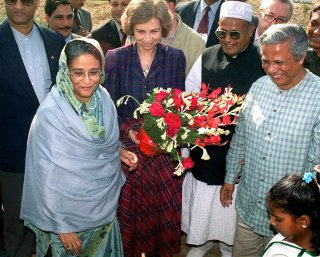
After terming him the “bloodsucker” of the poor and relentlessly harassing him and forcing his departure from Grameen Bank that he founded and led to Nobel Prize stature, Prime Minister Sheikh Hasina, on Wednesday, requested the visiting EU delegation to use their “influence” to make Prof Yunus the next president of the World Bank. 

On the occasion she also praised him, according to UNB news agency, for “his outstanding contribution in alleviating poverty through micro credit activities.” The PM is also quoted to have further said that Prof Yunus has vast experience and enjoys an “excellent reputation in the world”. She reportedly holds the view that Prof.

Yunus' vast experience is a “valuable asset” that the World Bank, by making him its next president, can use for the benefit of the world. 

This is for the first time we have heard anything positive from the PM about Yunus since she took power this time. Is Sheikh Hasina's change of heart for real? Or is it a mockery, with the underlying message, 'Take him away from Bangladesh?' We hope it is the former.

Countless numbers of us who have attended conferences abroad or who have done business with foreign companies, have faced relentless questions as to how the Bangladesh government could harass the very man honoured the world over. 

The support that the international community extended to Prof Yunus was seen by our government more as Yunus' capacity to lobby to gather support rather than a sign of genuine respect that he enjoyed. 

The spontaneity of the global outcry was totally lost on our government. It could not imagine, in its wildest dream, that another Bangladeshi, who wielded no political power, could have earned such a genuinely exalted place in the global scene. 

So like a stubborn individual, the more the support for Yunus, the more the government stiffened its attitude and saw it as external interference in our internal affairs. Not for a moment did it ask why heads of states and governments were rooting for this private man who had nothing to show for his power except his reputation for the work he did for the poor, especially women. 

Within the country the government, its leaders and especially the prime minister came under severe criticism for their narrow mindedness. Many termed the prime minister's attitude to be an expression of her jealousy, as some had convinced her that she deserved a Nobel Prize. She appeared to be mean, vindictive, too eager to denigrate people other than her family, and totally blind against people she dislikes for whatever reason and however unjustifiably. To make a long story short, her attack on Prof Yunus greatly diminished her, her party, her government and the country.

Nothing would please us more if Sheikh Hasina really meant what she said to EU delegation. It is never too late to correct a wrong. Yunus' possible presidency of the World Bank is of least interest to us. (It may be mentioned that the office is always held by an American, just as the IMF's stewardship is held by Europeans. On what basis our PM made such a request to the EU is beyond our comprehension). What is far more important for Bangladesh and we as a people is that we stop dishonouring a man who needs and deserves to be respected. We stop telling lies about him and about micro-credit that is being adopted in almost all poor countries of the world, some not too poor and a few rich countries as well. 

As the age old saying goes, charity begins at home. So also respect for Yunus should begin at home, at the PM's home (figuratively speaking) to be precise. 

If Sheikh Hasina believes what she said to the EU delegation about Yunus' work, his experience, his reputation then she must acknowledge that inside the country by giving him the respect he deserves. Given the ego our leaders have, it is too much to ask our PM to retract all that she has said about him in the past, especially after it proved to be all false. She would definitely gain the esteem of her countrymen if she had the maturity and the self confidence to admit that she was mistaken. 

That said, we can ask her to begin anew. She can start by giving Yunus an audience that he has long requested for and removing the misunderstanding that has been exploited by many smaller people surrounding the PM. She can take steps to restore this man's prestige that she has so unfairly, cruelly but at the end ineffectively, tried to take away from him. 

But, on the contrary, if she does not believe what she has said, then she has only made herself an object of ridicule. The world will know that she advised the EU and indirectly the World Bank and all its members to honour the very man she herself does not honour. What it will do for her own credibility and stature, not to speak of respect among her peers, is an open question. But it is one that should be asked by her. 

It is our fervent hope that the PM's words signal a change of heart. We would further like to hope that she will act according to what she has said and try to heal this festering wound that has harmed us all so much, more her than anybody else. However, if her words turn out to have been just that --- words, without any substance or meaning --- then it will stand out as having made a mockery of us all. 


Border management top on agenda

As effective implementation of the Coordinated Border Management Plan is likely to top the agenda of home minister Shahara Khatun's meeting with her Indian counterpart P Chidambaram on Friday, New Delhi is set to urge Dhaka to restrict movement of people along the border.

While Dhaka is expected to take up the issue of alleged excesses committed by India's Border Security Force (BSF) personnel on the citizens of Bangladesh, New Delhi is set to point it out that the policy of restraint implemented by its border guards had 'emboldened' the criminal elements active across the line between the two neighbours.

Sources in the India's ministry of home affairs said New Delhi would point out that taking advantage of the policy of restraint exercised by them, criminal elements active along the border had in the past few months stepped up attacks on the BSF personnel.

"There have been a number of attacks on the BSF personnel in the recent months along the India-Bangladesh border. A BSF head constable also got killed by smugglers, who came from across the border at Gobardah in North 24 Parganas district in West Bengal," said a senior official.

"We would stress that illegal activities, which sometimes lead to regrettable loss of lives on both sides of the border, need to be addressed through joint collaborative efforts and mechanisms," he added.

Shahara's meeting with Chidambaram is the second between the two. They last met in Dhaka in July last year, when the Coordinated Border Management Plan was signed.

The video footage of a Bangladeshi national being stripped and tortured by the BSF personnel along the border in Murshidabad district of West Bengal on Dec 9, 2011 triggered uproar last month, prompting Dhaka to lodge a protest with New Delhi. The BSF suspended eight soldiers, who were involved with the torture of the man, and also ordered an investigation.

Dhaka, however, is expected to raise the issue once again at the home minister-level meeting starting Friday.

But New Delhi maintains that number incidents of firing by BSF personnel or alleged excesses committed by them have came down drastically in the recent months as the paramilitary force was told to exercise as much restraint as possible, and that .

Sources in the Indian ministry of home affairs claimed that BSF has been exercising utmost restraint and resorted to firing in self-defence only in the recent months. Besides, New Delhi had also started arming the BSF personnel with non-lethal weapons apart from taking other measures, like round-the-clock domination and intensive patrolling as well as night time restrictions on the movement of people in the border areas.

"Unfortunately, this policy of restraint has emboldened criminal elements who have stepped up their attacks on BSF personnel deployed along the border in order to facilitate their illegal activities," said a senior official in New Delhi.

During his meeting with Shahara, Chidambaram is likely to stress that the Coordinated Border Management Plan envisaged joint responsibility of both BSF and Border Guard Bangladesh to synergize their efforts to ensure effective control over cross-border illegal activities and crimes as well as for maintenance of peace and harmony along the border.

"Illegal activities, which sometimes lead to regrettable loss of lives on both sides along the border, need to be addressed through joint collaborative efforts and mechanisms. We will continue to work closely with the government of Bangladesh to maintain peace and harmony along the border," said the official of the ministry of home affairs.

Chidambaram and Shahara will hold a one-on-one meeting before leading the delegations of the respective countries to the parleys.

A press-release issued by the India's ministry of home affairs on Thursday said that "issues concerning security, border management and enhanced cooperation between the police and law enforcement agencies between the two countries" would be high on agenda.

India's national security advisor Shiv Shankar Menon, home secretary R K Singh and foreign secretary Ranjan Mathai would be members of the Indian delegation to be led by Chidambaram. The Bangladesh delegation would include prime minister Sheikh Hasina's advisor Gowher Rizvi, Bangladesh high commissioner in India Tariq A Karim and senior secretary of the ministry of home affairs C Q K Mustaq Ahmed. 


EU shocked by killings at border

The killing of Bangladesh civilians on the border by the Indian Border Security Force is shocking and should be strongly addressed, Jean Lambert of European Parliament said yesterday.

She made the remarks replying to queries at a press conference in Dhaka yesterday.

“This is going on for a considerable period,” she said adding that the matter would be raised in European Parliament and with the Indian ambassador in Brussels, the de facto capital of the European Union. It will also be taken up with the European delegation visiting India.

Lambert is the leader of a seven-member delegation of the European Parliament for Relations with South Asia. The delegation came to Dhaka on a five-day visit on February 19. 

Without mentioning the BSF chief's name, she said the comments that the killing is inevitable were outrageous in terms of human rights.

European Union Ambassador in Dhaka William Hana was present at the press conference. 


Border firing to go on

Reasserts BSF chief day before home ministers' meeting in Delhi.


Indian Border Security Force chief UK Bansal yesterday reaffirmed that his soldiers at the border with Bangladesh would fire on criminals who dare them, a statement that has already created controversy over border killings.

"If, despite their [BSF personnel] efforts [of exercising restraint], they get into a situation where they are threatened and their lives are in danger, then they will use the force available to them to save their lives or the lives of their companions. That means they will fire," Bansal told Press Trust of India news agency.

According to rights organisation Odhikar, 203 people lost their lives in BSF firing near the border between 2009 and 2011. 

None of the killings occurred in a situation in which the Indian guards' lives were at stake.
Triggering a controversy, Bansal had earlier said firing by BSF along the border with Bangladesh cannot stop completely.

The BSF chief, however, made it clear that firing will be the last resort and that the force has put in a number of measures to avert casualties.

His remarks came a day ahead of a meeting between Home Minister of India P Chidambaram and Bangladesh Home Minister Shahara Khatun. When the two ministers meet, Shahara is expected to raise the issue of BSF firing and killing of Bangladeshi civilians along the border. 

Yesterday the BSF director general said, "They [BSF personnel] will fire with the available weapon... it may be non-lethal, it may be lethal... every patrol company will have both weapons but if a person is under attack and he is holding a rifle, he will fire his rifle.

"Even that firing he will do as far as possible with the intent not to kill but if casualties occur... we will have to tolerate it as an inescapable alternative," he said.

"It gives me no pleasure in killing any civilians. We have the best of relations with Bangladesh. We want to improve those relations... but we certainly cannot sacrifice the lives of our officers and men and we also have to complete our mandate which is border guarding and, therefore, we are trying to strike a difficult balance between completing our task with as little force as possible," Bansal said.

He said the BSF is sending a fresh lot of non-lethal weapons to 23 border posts along the Bangladesh border. However, he claimed that since the time BSF decided to exercise "restraint" while dealing with cross-border movements, criminals have become bold.

"They are coming in larger numbers... sometimes even 300-400 at a time. They are breaching the fence with the confidence that they can get away with it... Cattle smuggling is being attempted with much greater openness," Bansal said.

"Some people say these are cattle traders and that BSF is killing them. My question is what trade is done in the middle of the night? From dusk to dawn, on the entire Bangladesh border we declare curfew and no movement is permitted. Whether Indian or Bangladeshi, he has no business to be there... So, to say that these people are innocent traders is not a very convincing argument," he said. 

The DG said the BSF has asked the Border Guard Bangladesh to ensure strict vigil in vulnerable areas during the nights.

He claimed that since Chidambaram's visit to Bangladesh in July last year and subsequent order to exercise maximum restraint on the Bangladesh border, firing incidents have come down by "about 70 percent".

Meanwhile, Home Minister Shahara Khatun reached New Delhi yesterday afternoon leading a 12-member delegation including Gowher Rizvi, international affairs adviser to Prime Minister Sheikh Hasina, Bangladesh High Commissioner to India Tariq A Karim, and Home Secretary Mustaq Ahmed. 

Before the talks with her Indian counterpart, Shahara is expected to call on Indian Prime Minister Manmohan Singh at his residence around 10:00am today. 

Home secretaries of the two countries held a preparatory meeting yesterday at the Indian home ministry ahead of the talks between the two home ministers.

Meanwhile, an official statement of Indian government last night said Chidambaram and Shahara would have one-on-one meeting before the delegation-level talks today. 

Issues on security, border management and enhanced cooperation between the police and law enforcement agencies of the countries will be high on the agenda. 

India's National Security Adviser Shivshankar Menon, Home Secretary RK Singh and Foreign Secretary Ranjan Mathai would be in the Indian delegation.

The meeting of the home ministers of Bangladesh and India take on the added significance with the presence of Gowher Rizvi and Indian National Security adviser Shivshankar Menon, said officials who regularly attend ministerial-level talks between the two sides.

This clearly indicates that the home minister-level talks would focus on all issues relating to security cooperation between the two sides, especially the drives against terrorists and criminals.

Sources said India is likely to ask Bangladesh to consider imposing night curfews along the border to prevent movement of people like India has done.