Pages

Wednesday, April 11, 2012

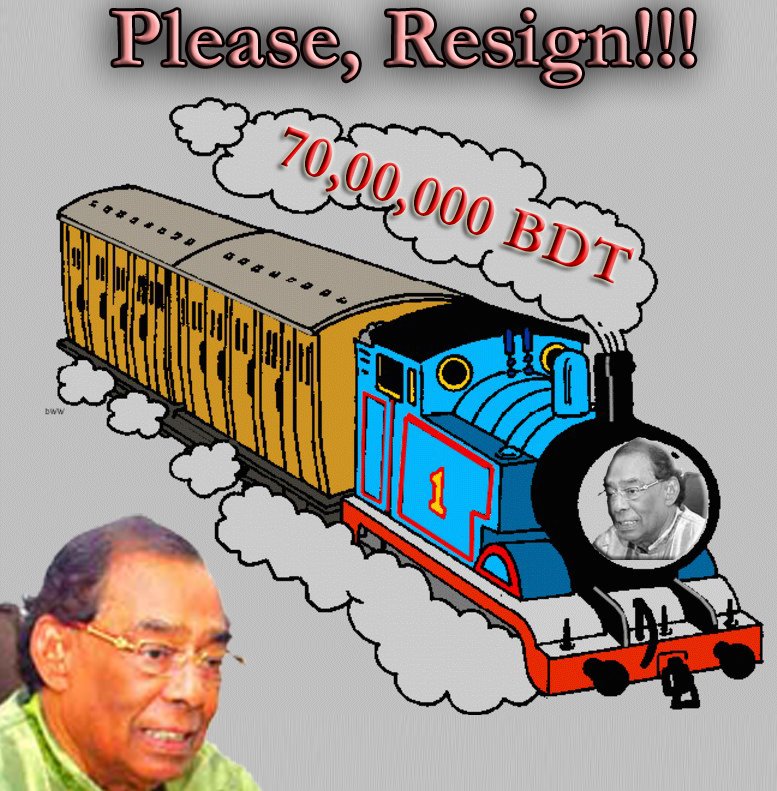
'Railway-gate' Scandal Suranjit comes under fire

Govt embarrassed; BNP asks minister to go; ACC to probe; Tk 70 lakh alleged to have come from recent recruitment.


Railway Minister Suranjit Sengupta received heavy flak from various quarters over the seizure of Tk 70 lakh from his assistant personal secretary's car Monday night and his handling of the matter afterwards. 

The parliamentary body on railway ministry and officials of railway and other ministries alleged that Suranjit took the matter very lightly. They questioned how neutral the two probe committees, formed by the minister, would be when an officer of the same ministry would be investigating his subordinates. 

Even the Anti-Corruption Commission joined the bandwagon yesterday. The watchdog said it would launch a probe into the minister's alleged involvement in the incident, reports Channel i, a private TV channel. 

Meanwhile, the opposition BNP demanded the minister's resignation while the parliamentary body launched a probe into the ministry's handling of tenders over the last three years. 

The money found in the car is believed to be bribes from railway job seekers.

On late Monday, Ali Azam, driver of Suranjit's assistant personal secretary Omar Faruq Talukder's car; with him, Railway's General Manager (East) Yusuf Ali Mridha and Chief Commandant Enamul Huq on board drove the car into the Border Guard Bangladesh (BGB) headquarters in Pilkhana in the capital. When guards at the gate rushed to the vehicle for unauthorised entry, the driver told them there was bribe money stashed in the car. The guards discovered Tk 70 lakh in the car and they detained the four. 

adesh (BGB) headquarters in Pilkhana in the capital. When guards at the gate rushed to the vehicle for unauthorised entry, the driver told them there was bribe money stashed in the car. The guards discovered Tk 70 lakh in the car and they detained the four. 

The BGB personnel wanted to hand them over to police but police refused to receive them saying there was no case filed against them. Faruq, Yusuf and Enamul were eventually released but the driver is said to be still in BGB custody.

The Daily Star failed to reach the driver for comments despite repeated attempts on his two mobile phones. 

BNP acting secretary general Mirza Fakhrul Islam Alamgir during a demonstration in the capital against price hike of essentials called for Suranjit's resignation. He said the minister should shoulder the responsibilities of what has happened, reported UNB. 

Suranjit, clearly on the back foot, held a press conference yesterday and said Faruq and Yusuf had been asked not to come to work until further notice. 

“This was unwarranted,” Suranjit Sen Gupta told the press, adding, “In a country like ours, this kind of incidents has happened before. This incident has created problems for me. I will face it.”

When the press asked if he had suspended them, he was rather vague and said, “You can also think like that if you want.”

However, after the seizure of the money the minister had told a press briefing at Rail Bhaban that the two would continue work since they have not been proved guilty of any wrongdoing. He denied that Enamul was even in the car.

Late last night, Suranjit's personal secretary sent a letter to the secretary of the ministry informing him of Faruq's suspension from yesterday morning. 

Sources in the railway said Rail Sramik League, ministers, lawmakers, ruling party leaders and a section of corrupt railway officials were taking bribes from job seekers. The railway ministry recently started recruitment of 7,500 people.

A senior railway official on condition of anonymity said, “Tk 2 lakh to 5 lakh is being taken from each candidate.” 

During the meeting of the parliamentary body on the railway ministry at the Jatiya Sangsad Bhaban yesterday, a number of lawmakers came down heavily on the minister over the issue. 

They even questioned how an APS has a lawmaker's sticker on his personal car.

The parliamentary body yesterday formed a five-member sub-committee headed by lawmaker Shah Alam to probe alleged irregularities in awarding tender under the ministry's various projects in the last three years.

BNP MP Rehana Akhter Ranu, a member of the parliamentary body, demanded that the government forms a judicial probe committee for this. She said Suranjit must resign for the sake of impartial investigation. 

Rehana said, “We believe the minister's APS and a general manager of the ministry were carrying the money to give him [Suranjit] as bribe in exchange for recruitments in the ministry.” 

Other members, including a ruling party lawmaker, of the standing committee asked the minister about the alleged corruption in recruiting employees in the railway ministry. 

Suranjit, also a member of the parliamentary body, said such incident was unexpected and he would place the enquiry reports of the two probe committees before the parliamentary body and take actions as per the committee's directives. 

Suranjit refused Rehana's demand for judicial probe.

Talking to The Daily Star, several railway officials and employees said the three--Faruk, Mirdha and Enamul--should have been suspended immediately and an independent investigation body should have been formed.
Joint secretary (administration) of the railway ministry Shashi Bhushan Singha was assigned to investigate the involvement of Mirdha while minister's Personal Secretary Akhtaruzzaman was probing the involvement of Faruk.

“How can the minister's PS be assigned to investigate such an incident since both work closely?” a mid-level official told The Daily Star at Railway Bhaban yesterday. He said an official of the ministry could not probe irregularities of an official of the same ministry.

Another junior official said he suspected that proper investigation would not be possible by the probe committees. “Officials of other ministries could have easily been engaged in the probe,” he said, requesting anonymity.

Another official said, “There are allegations that many of us are chor [thieves]. This is the proof of that.”
The official said if Yusuf was quizzed, everything would be revealed.

Meanwhile, the Railway Bhaban yesterday looked desert since morning as almost no senior officials attended work. 

GOVT, AL EMBARRASSED
The government and the ruling Awami League were embarrassed by the incident, The Daily Star found out after talking to several leaders and ministers. 

However, none agreed to make official comments.

“It is really embarrassing for the government and the party as well at this time [late part of the government's tenure],” said a minister requesting not to be named. “It is a very sensitive matter…”

The minister said they would discuss the matter with the prime minister upon her return from Turkey on Saturday. 

Highly placed government sources said that before her departure, the prime minister has asked the railways minister to suspend his APS immediately.

Awami League Deputy Office Secretary Mrinal Kanti Das, however, said there might be a conspiracy behind the incident. It could have been staged to disgrace the government.

ACC TO PROBE
Anti-Corruption Commission Chairman Ghulam Rahman yesterday said the commission would investigate the allegation of bribe against Railways Minister Suranjit Sengupta.

“There used to be no investigation into any allegation against ministers in the past, but now the graft watchdog will probe,” he said, addressing the concluding ceremony of a training programme for the newly-appointed 28 ACC Assistant Directors, reports UNB.

The ACC chairman also said the commission would also conduct an investigation into the allegations of corruption in the Padma bridge project and against the company Destiny 2000.

Saturday, April 7, 2012

India dumping Nuclear waste In Bangladesh

Power failure is now a regular phenomenon in Bangladesh, where the ruling party made specific pre-electoral pledges to the voters of greatly resolving the crisis within the first two years of being in the office. But, reality speaks something else! The current government of Bangladesh Awami League, which leads coalitions of Islamists, leftists and former dictators has greatly failed in addressing large number of national issues, including controlling the prices of essentials, maintaining the law and order situation, getting proper share of water in various rivers from India, stopping campus violence (which are mostly committed by the members of the student front of the ruling party), ensuring rights of the religious minorities, combating terrorism, rape, murder and extortion (again mostly committed by the members of the ruling party) etc.

In brief, this is a worst form of failed governance by Bangladesh Awami League since the creation of the country in 1971. While lives of people have already fallen into the ditch of severe sufferings due to series of adversities, the ruling party, instead of making genuine attempts of resolving the same as rather seen engaged in making fun of people’s agonies as well as continuing limitless looting of public wealth by letting bunch of pro-ruling party looters robbing off billions of dollars from the national exchequer by installing questioned projects such as rental-power stations as well as making false billings from the private owned power plants in the country. At the same time, instead of endorsing people’s sufferings and giving any specific description of government steps in resolving the power crisis, the Prime Minister is making mockery and joke with the entire nation right inside the National Parliament, where she said, load shedding were continuing in the country to remind people about the shortage of power.

Members of the cabinet as well as talkative figures in the ruling party are equally engaged in giving irritating statements possibly with the mission of hiding the huge failures of Bangladesh Awami League in resolving the power crisis, which not only causes acute sufferings to the citizen of Bangladesh, but also are already putting country’s industrial sectors into mere devastation. Foreign investors are no more eyeing on Bangladesh due to two major reasons – one of which is acute power crisis, while next is a total lawlessness in Bangladesh. Members of the youth and student fronts of the Bangladesh Awami League are continuing various forms of illegal activities in such open manner as if they are licensed to commit crime. Law enforcing agencies are either afraid or shy in taking any steps against such notoriety of the ruling party inmates, as any such actions by the law enforcing agencies would only invite dire consequences in his/her service life.

Nuke power and hazards for the civilians
As a bid to resolve the existing acute power crisis in Bangladesh, the ruling party has signed an agreement with Russian Federation for establishment of 2000 mega watt nuclear-based power plant in the country. Experts feel, there are several risks associated with nuclear power plants. The most serious is the question of nuclear waste. Using nuclear power generates radioactive waste which will be radioactive for thousands and thousands of years. Storing such wastes in such safest method, where humans and plants will not be affected is the biggest challenge, because such wastes cause dangerous radiation.

The storage of the waste is an extremely difficult problem to solve, both on a technological and scientific level, but also on a political level. Currently, all the nuclear waste generated by humans on earth is stored in temporary sites. This temporary solution will not be acceptable in the long term. The other major effect of nuclear reactors on the environment is that they need water to cool them. They are often built near a river for this reason. Because the water is used to cool them, that means the water is being heated by the plant. This can raise the average temperature of the water in the river. Changing the temperature of the water can have a very serious and detrimental effect on fish and other organisms living in the river.

India dumping nuclear waste in Bangladesh
India now envisages increasing the contribution of nuclear power to overall electricity generation capacity from 2.8% to 9% within 25 years. By 2017, India’s installed nuclear power generation capacity will increase to 10,080 MW. As of 2009, India stands 9th in the world in terms of number of operational nuclear power reactors. Indigenous atomic reactors include TAPS-3, and -4, both of which are 540 MW reactors. India’s US$ 717 million fast breeder reactor project is expected to be operational by 2012-13.

Each year thousands of tons of nuclear wastes are released from the nuclear power plants, dumping of which is one of the biggest challenges. Since 2001, India has started exporting its nuclear wastes by mixing the same with ash from the thermal power stations. Bangladeshi cement manufacturers alone imports more than five hundred thousand tons of fly ash from India and produces fly ash mixed cement.

The whole concept was first initiated by a company named Holcim, which later successfully infected the idea into the brains of other cement manufacturers in Bangladesh. Through such notorious steps of Holcim and subsequently by other cement manufacturers in Bangladesh, most of the newly constructed domestic and commercial buildings in the country are now becoming slightly or significantly polluted with nuclear contamination, which not only poses huge threat to human lives but also puts substantial threat to the very environment of the country. India also is exporting its nuclear wastes to some other neighboring nations as well as countries in the African continent as well as in the Middle East either by mixing with thermal-power plant generated ashes or with other chemical compounds.

Energy price increase crossed all past records
During the three plus years of rule of the Bangladesh Awami League led leftist, Islamist and former autocrat coalitions government, the increase of fuel as well as energy in Bangladesh has crossed all previous records, while there even had been multiple increases simply within the span of a month. The rulers are trying to convince people stating such increase were necessary to cope with the increase in prices of fuel in the international market, it is clearly understood that such increases were necessary to cope with the huge pressure on country’s economy as well as foreign currency reserve as billions of dollars are rather wasted on feeding the quick-rental power plants as well as those power companies, who are making fortune by virtually robbing such public money through false billings in connivance with some corrupt officials as well as unscrupulous political figures.

Due to such mad increase in prices of fuel and energy, cost of living has greatly increased in Bangladesh, though income never increased in comparing to the degree of such exorbitant increase in the prices of fuel and energy. At the same time, country’s economy is also under huge pressure due to decrease in foreign currency earning as labor market for Bangladeshi workers is shrinking fast, again due to inefficiency of the ministry and departments concerned. There had not been any mentionable foreign investment in the country for past five plus years, as political instability, power crisis, terrorism and massive corruption stood as barriers, where foreign investors are no more considering Bangladesh as a potential ground for their investments.

Though the only good news of these series of bad news is, Bangladesh may now become important ground for many petroleum exploration companies in the world, after the recent resolution of maritime boundary dispute with Myanmar, though many feel that the real result would only be possible if Bangladesh could also settle the dispute with India. The ruling party in Bangladesh is trying their best in portraying the recent resolution of maritime boundary with Myanmar as Sea Victory, which political analysts see as mere political stunt of Bangladesh Awami League, which is badly suffering from series of its failures only during past three past years.

Freedom of media and expression
For the current government in Dhaka, media and public opinion has already become its worst enemies, as the real picture of the failures of the ruling party is clearly portrayed in the media as well as public opinions. The ruling party is trying to apply numerous tricks and policies in somehow suffocating the freedom of expression and rights of the civilians. Opposition parties are regularly obstructed from even peaceful demonstrations against the ruling party and well-planned repressive pogroms are continuing on the political opponents as well as different opinions of the ruling elites in Bangladesh.

Risk of mass revolt
Whenever there is huge repression on civilians as well as attempts of suffocating the freedom of expression and media in any of the nations in the world, there surely is the possibility of outbreak of mass revolt, even in some cases, led by some individual or group, not representing the so-called mainstream parties or groups. In Bangladesh, power crisis is causing huge anger in the minds of the mass people, which is certainly an alarming sign for the rulers.

Currently the average daily load shedding in the rural and urban areas are between 10 to 18 hours. There are indications that such timing may even increase during the month of May and September. Especially the months of May, June, July and August are the hottest summer days in Bangladesh. Political opponents of the ruling party have already picked up the issue of power crisis at the top of their anti-government agendas, which surely is a hugely alarming sign for Bangladesh Awami League. According to political analysts, power crisis is directly affecting the lives of the civilians, where they would voluntarily react and even revolt, if they are given lead by any individual or organization. The analysts also say that the ruling party may use state machinery, law enforcing agencies as well as armed cadres of their youth and student fronts in confronting any such mass revolt, but ultimately it may push the entire nation towards a destination unknown.

According to the analysts, people are already fed up with the increasing sufferings due to load shedding as well as ruthless statements of the ruling elites. Their hidden anger may spark at any time and turn into a huge political inferno for the Bangladesh Awami League. In face of such political eruptions, it will be almost impossible for the ruling party in tackling the situation.

Understanding such political advantageous point, the main opposition Bangladesh Nationalist Party, Bangladesh Jamaat-e-Islami as well as minor parties such as Bikalpa Dhara Bangladesh, Khelafat Majlish, Islamic Unity Front, Bangladesh Khelafat Andolan, Bangladesh Jatiyo Party, Islami Oikya Jote, Gono Forum, Bangladesh Kalyan Party, Liberal Democratic Party, Islami Movement Bangladesh, Jatiyo Gonotantrik Party etc have already started bringing the power crisis and load shedding as well as increase in the prices of fuel at top of their political agendas.

It is anticipated by the political pundits that, much ahead of June 12 political deadline set by Begum Khaleda Zia, former Prime Minister and leader of Bangladesh Nationalist Party, political mercury in the country may touch alarming level or even may give birth to any sudden spark in civilian unrest or mass revolt. Sensing this, Bangladesh Nationalist Party is also re-fixing its political strategies against the ruling party and are believed to be planning to begin massive campaign in the country, protesting Bangladesh Awami League led government’s failures in addressing this important problem, which understandably is aimed at mobilizing millions of people towards the June 12 hard line programs of the main opposition party and its alliance partners.

There is no doubt the ruling party will also apply its all out forces in confronting the political programs of the opposition. And of course, if such confrontation will be similar as the past, there is sufficient room to fear any uncertainty in the country, which may not be any good news for the democracy itself.

Yunus Victim or Villain of Bangladesh Government

Poverty is a curse, which existed from times immemorial and the noble efforts of the Nobles of the Human Race to eradicate it, has never stopped, either; But unfortunately poverty has become the part and parcel of Human Race and is there to stay thriving, no matter what the Humans do to eradicate it.

Poverty is cruel and makes its own history at its own timing and choosing. Dr. Yunus, the founder of Grameen Bank, the Noble prize winning anti-poverty crusader, became its latest victim last year, when the Bangladesh Government decided to remove him from the helm of the largest poverty alleviation bank in the World – Grameen Bank. Litigation was launched against his removal in the courts, but the battle was legally lost. The Political leadership at the highest levels of the Government of Bangladesh is somehow averse to the idea of Dr. Yunus performing any role in Grameen Bank and its sister organizations.

The battle between Dr. Yunus and the government of Bangladesh does not end there; rather it is still ongoing and is being fought in different capitals of the World. Bangladesh government tried unsuccessfully to convince the International supporters of Dr. Yunus to shed their support for him. Domestically the conflict and the news surfaced, when, 9 newly elected Directors of Grameen Bank Board, representing 75 percent shareholders of the Bank, in their first Board Meeting on March 19, 2012, unanimously recommended, that Dr. Yunus should lead the search committee for the New Managing Director of the bank.

It is reported, that the outgoing 9 members of the Board of Directors of Grameen Bank, who left office in January 2012, after completing their three-year tenure, in their 93rd Board Meeting on July 26, 2011 also recommended to include Dr. Yunus, as the chair of the new search committee for the Managing Director. But Khondaker Muzammel Huq, Chairman of the Board, has reportedly said, that there is no scope to make Dr. Yunus the head of the search committee, in the light of the Supreme Court verdict, which said the Dr. Yunus continued in the office of the Managing Director of Grameen Bank, unlawfully for more than 10 years.

The issue came to fore again, as per The Daily Star of April 4, 2012, after a sudden burst from the Finance Minister AMA Muhith, highlighting the government position of not making Dr. Yunus the chief of the selection committee, although the Grameen Bank Ordinance 1983, that governs the microfinance organization, empowers the Board to form such Committee.

Dr. Yunus has done proud to the country by winning the Noble Prize, not the first Bengali, but the First Bangladeshi to do so. He has many achievements to his credit, but he is human and to err is human, therefore it is normal, that he made a few mistakes down the road also. Dr. Yunus enjoys tremendous respect in different capitals of the World irrespective of which school of thought is in power in those countries. He has been welcomed in many a parliament and elected chambers of the different countries of the World and honored with plaudits. Americans and Europeans in particular and numerous other countries and world leaders speak almost in one voice in his support in respect of Grameen Bank complexities and in support of his various noble initiatives and projects worldwide.

Dr. Yunus is a man who cannot be written off or belittled by the efforts of a few elected politicians, whose tenure last till the next verdict of the eligible voters. Dr. Yunus wants to make "poverty history", but in turn poverty is giving him the opportunity to make history out of himself and his contributions to the eradication of poverty. Bravo Dr. Yunus. He has been elected/selected to the noble heights and is supposed to stay there forever irrespective of what the Bangladesh political elite want or dictate.

He made the uncanny mistake of venturing into the uncharted and choppy sea of Bangladeshi politics immediately after winning the Noble Prize. It is reported, that it was not his decision, rather the miffed third forces comprising a section of the intellectuals and civil society elites convinced him, that his newly earned noble capital had the powers to topple the two clan political system in Bangladesh. It was a mistake, well made as Dr. Yunus himself confessed, using a famous Bengali line later, that the "balds don't go under the wood-apple tree the second time". Besides, the utterings of Dr. Yunus on many occasions later confirmed his non-political desires. The political hierarchy of the ruling Awami League is not the least inclined to accept his defenses.

Another joke making rounds in Bangladesh is that the Noble Peace Prize is something that can be bought or earned through maneuverings and can be had by the political heavyweights with family lineage and peace and progress related achievements. The history of Noble Peace Prize winning candidates doesn't go to prove the above "joke", rather it is given to people with outstanding contributions towards the establishment and winning of peace through singular or multilateral approach.

This peaceful looking battle with the Noble Peace Laureate is not going to take the Bangladeshi government anywhere, rather it is hurting the country in manners and means unimaginable. Bangladesh government should have used Dr. Yunus as a bargaining chip with the international community, especially the American and European supporters of Dr. Yunus in winning concessions for the country and furthering the political cause of the government in power. There is still time for the government to realize the consequences of hurting the international sentiments, which initially looked favorably to its rise to political power again in Bangladesh after the 1/11 debacle.

Peace is a process which needs to be initiated from any platform or sector, and the sole purpose should be to promote peace among mankind as a whole, without any pride and prejudice. This writer and WeeklyBlitz thinks, that it is time for the Political elites of Awami League to make peace with Dr. Yunus. Making peace with Dr. Yunus will definitely earn the government the desired credits towards noble achievements of earning the future Nobles for Bangladesh.

Whatever Bangladesh Government finally does in respect of Dr. Yunus, they will not be able to make him either a victim or a villain, because he is none and cannot be made into any, because he enjoys the status at noble heights, where victims or villains have no place at all. 


Tyranny of "Majority Rule" in Bangladesh

It's all about "broken PROMISES", deceits, betrayal and consequences!

The "Town Government" of Hamelin, Germany did not keep their promise, made to the Pied Piper that ended up with a painful tragedy to 132 minor children about 800 years ago. If not moral, it is always a Constitutional as well as mandated civic duty of all elected public representative to keep their promises. If and once had the Hamelin administration complied, the fates of 132 poor children would never end up in embracing miserable destiny, exactly the way they did.

Robert Browning enervated more intimidating spirits into, for taking lessons from "The Pied Piper of Hamelin".
"So, Willy, let you and me be wipers

Of scores out with all men -- especially pipers;

And, whether they pipe us free from rats or from mice,

If we've promised them aught, let us keep our promise".

Bangladesh is sinking everyday under a "Majority Rule" foreign run government. This hypnotized nation of 160 million sleep-walkers feel increasingly alienated from their (Hasina) government who "secured" democracy in her Head with bloods and an extremist vision in her heart, and is refusing to address nation's exigent problems. However, the tyranny of the "Majority Rule" is not "that's all" in Bangladesh those have been reigning and ruining all the fundamental norms of civilized democracy for almost 40 years now! Nation's trusts in its supreme politicians have been engulfed by the dangerous flames of inveterate lies, circular betrayal, defiant deceptions and false promises. Political fields in Bangladesh have become a breeding ground of hatred, vengeance against opposing political "enemies" those virtually transformed entire country into a precarious combat-zone like a War Field. It is equally strange and unusual to see that many of our national flag bearers of aggressive patriotism have also been defending all their lies and deceits from both Awami League and BNP chiefs. These individuals have mysteriously been allowing themselves to be manipulated by both Hasina and Khaleda as well as other powerful characters in national politics.

Multifarious show downs between Prime Minister Sk. Hasina and the opposition leader Begum Khaleda Zia (BNP) have been dumping more fuels into the crater of an erupting volcano. Churlish Hasina has fully mimicked almost all her father's egregious blunders including many of her own leading to much of the political predicament in which the nation finds her today. Their polemical attacks and counter-attacks on each other have plunged into a personal level assault battle, defying all norms and propriety of a national leadership position in a civilized democracy. Mustafizur Rahman, Executive Director of Center for the Policy Dialogue (CPD) said, "Politics of compromise and constructive engagement of the two major political forces is vital for Bangladesh but who cares for the national interest"?

It is important to recognize that we accept "Majority Rule" because we do not believe that it will threaten us in our private, family and public life and that we think of ourselves having the power and righteous "moral authority" of the majority. Majority-rule democracy has always rested on the conviction that if all the facts were clear, everyone could be made to see that there is only one right course of action, the people—and without this belief, it amounts to nothing other than the dictatorship of a group of tyrants exactly like in Bangladesh. All we need a democracy in which we are free from the mob rule of the majority as well as the ascendancy of the privileged class. In Bangladesh, the "Rule of Just and Equal Law" only protects the interests of the powerful few, those are engaged in the business of Politics, horse traders in the administrations but does not protect the poor citizens from injustice that simply created arena of corruptions, bribery, grafts, nepotism and violence. The Rights of the mostly poor are the very last thing to be protected by the "checks and balances" of Bangladesh democracy since the power is already reserved for those with the privilege to seize it. Our judiciary has also become a theater of clowns and pompous judges.

Mission of our Freedom and the teachings from 9 months united struggles during 1971 have long escaped from the "souls" of our nation's top leaderships. At this point, looks like we do not need to invite foreign enemies to destroy the structures of our democracy, our images to the international community and most importantly, our sovereignty at large. Circumstantial observations and field realities make it clear that we ourselves are devils enough in transforming this nation into a miserably failed institution! The tasty & feuding relationship between the 2 Pied Pipers of Bangladesh, especially Hasina and her "beneficiaries" are sending wrong signals to the most extreme elements of our society that perhaps violence would again become a justifiable response at some point. Just like, those were in the history of our past when the enemies of democracy got a bellyful of the political explosives.

So, what "good" did the so-called "Majority Rule" exactly deliver to this poor nation for last 41 years? Is there really anything good to say about, instead of biting each other and dividing a peace-loving nation?

Sadly, we have so far never tasted the flavor of a "civilized democracy" since its inception as a free nation; our democracy was first choked around its neck to death by our founding father Sk. Mujib himself with his declaration of "State of Emergency" on 25 January 1975. Mujib's pet Parliament then "democratically" amended the Constitution under State of Emergency, banning all opposition political parties and declaring Mujib the "President for life", giving him extraordinary administrative power! As its continuation, our Democracy of "Accountability and Transparency" fell into the "BLACK HOLES" of 2 splenetic political characters, Hasina and Khaleda 20/21 years ago and instantly vanished into nothingness since then.

Both these ego driven ladies have been running the country to the ground instead of running it. True patriotic elements should now come forward to rescue this failing nation before skidding down to a point no return.

"Road to Democracy in Bangladesh" now needs an alternative approach instead of a conventional one or the brasses of so-called "free and fair election". A sick nation must need the medicines of bad tastes and its democracy must come out through the barrels of guns like in Japan and in Germany after World War II. 

Nation simply can't effort giving out free rides any longer to this notorious bunch of thieves. The upcoming election, likely in November 2013 must be conducted under Emergency Role that would protect the security and freedom of choices of 160+ million citizens, prevent all political hegemony, deaths of innocent voters, secure a "free and fair" election and finally prevent the losing "Patriots" from digging for excuses of calling it a fraud election.

The President may consider calling the armed forces to crack down on all the "unruly and hostile patriots" in both AL/BNP camps those would attempt fomenting lawlessness, shall prevent them from hurting our law abiding citizens during their rancorous election campaign (for survival). If any untoward situation or development warrants, President could also consider dismissing the Care Taker Government, postponing the election indefinitely and declaring Martial law for 3 to 5 years or until the country becomes ready for a "free and fair" election. Politicians must understand that only the Care Taker Government alone can't secure a "free and fair" election unless political parties come up with open mind toward accomplishing that mission.

God doesn't give Hasina/Khaleda a position of authority to abuse and exploit it but to make their own nation better. Both of these incompetent political role models ran/ run Bangladesh from their own party holes only.

See, you can't sacrifice what you don't have! They, especially Hasina always hides her ugly face behind the huge billboards of patriotism and pro-liberation force to shine. I find both Hasina & Khaleda value-deprived buffoons with empty upper chambers. They will forever remain testaments to the stupidity, arrogance, greed and narrow mindedness in spurious Awami League/ BNP leadership along with their greedy lieutenants those shall also share the toasty quarters in the basement of the Hell of eternity (for unjustly depriving this poor nation). 


Friday, April 6, 2012

Is there an end to endless power outages?

Ailing and limping, the country’s power sector is in the doldrums. On Wednesday last a Bengali daily from Dhaka front-paged, “Power crisis is terrifying”. Indeed, power outages have become widespread amid fear of further woes by erratic electricity supply, while it is affecting the lives of the dwellers with about six to seven hours of outages in a day. Load-shedding in the summer may be worse than that of the previous year.
 
The country’s overall electricity generation is now hovering around 4,500 MW, but during the summer the demand will be around 7,000 MW. The BPDB is learnt to have proposed a load management proposal to the energy ministry from one hour to four hours a day during the summer to cope with the electricity supply shortage.
 
Headlined “Tk 20,000cr fuel subsidy this year”, a news report detailed the subsidy issue towards the end of last year. Although Bangladesh has revised retail fuel prices and power tariff frequently this fiscal year, the government would have to pay up more than Tk. 20,000 crore, which is highest so far, as fuel subsidy, as reported in an English daily on 15 October 2011. The Bangladesh Power Development Board (BPDB) opined that fuel consumption is expected to cross seven million tonnes, up from an average three million tonnes in the previous decade. In 2010, the country imported 4.8 million tonnes at a cost of Tk. 29,000 crore, which is expected to cross Tk. 49,000 crore. According to the central bank’s letter of credit (LC) settlement statistics, import of petroleum surged 135 per cent in the July-September quarter, this fiscal year, compared with the same period last year.
 
The country’s demand for power used to be met by gas extracted from local fields. But gas supply has failed to meet the rising demand for electricity, leading to chronic power shortages. According to the Bangladesh Petroleum Corporation (BPC) the main reason for soaring oil consumption was the introduction of privately held fuel-based quick-rental power plants, as well as a rise in captive power plants at factories. The oil subsidy bill in the 2011-12 financial year will rise to more than Tk. 20,000 crore. 
 
Power generation by such plants started last year. Before that, Bangladesh used to import 32-35 lakh tons of fuel every year.
 
The government permitted private companies to install 24 power plants with a total generation capacity of 2,770 megawatts. Afterwards, the government permitted some more privately-owned power plants. Initially, the project tenure was for three to five years, but for some projects, the lifeline is about 15 years, which, according to economists, is not judicious at all.
 
It is common knowledge that it has become a jigsaw puzzle that while government claims addition of 27,000MW of electricity to the national grid and often laying foundation stone of new power stations and also inaugurating new plants’ operation here and there, curiously load-shedding has reached a unbearable scale in recent times crippling the life of the people, forcing mills and factories to close shutters. The country is set for higher growth trajectory (7.5pc) in the next fiscal. 
 
Controversial indemnity bill
In an article entitled “Bangladesh Energy Sector: Crisis Compounding” dated October 14, 2010, an engineer in a blog opined, “Failing to conclude some major power project contracts following the customary process the AL Government has enacted the controversial indemnity bill for managing power and energy sector contract awards on unsolicited offers”. He cogently questioned, “Why democratic government actions cannot be challenged in court?” [Reference explorexdark@gmail.com] He is not alone; many people are asking the same question.
 
But, almost certainly the economy is in a much lower growth path than what is suggested and when the BBS begins to put the accounts together many top economists bristling on the economic border rightly or wrongly think that they’re in for a big surprise. To make things worse, last week power tariff went up: retail consumers are to pay more. It is the second hike this year and the fifth since the AL government took office in 2009. But by many yardsticks, it may not be an equitable solution to all. Besides, the consumers are flatly denied quality service—power supply without interruption. However, the hike, a typical one, is liquid fuel cost adjustment. 
 
PDB’s losses
The PDB ran a deficit of Tk 40bn in this FY12 with government subsidy of Tk 370 milion only. Government had no other option, as if tariff was not increased, the power board would clock losses to the tune of Tk.560cr for Jan-June period this year, as the prices of diesel and furnace oil (2 basic raw materials to generate electricity) went up by Tk.5 a litre last December. PDB high-ups should also strengthen the internal audit system of the state-owned agency for enhancing management and maintenance efficiency to slash subsidies in the power sector, such as checking the turbine blades at plants like Ashuganj. 
 
In the current FY, the government is set to allocate Tk.20, 000cr more in subsidies for the sector and according to the Finance Minister in JS, the government already owes Tk.40,000cr to the commercial banks. 
 
Government will have to bring forward the subsidy burden in the upcoming budget amidst a period when the Finance Minister said at BMA on 31 March that it will take another 8-10 years to anchor a suitable position for our present moribund economy if the political instability persists. 
 
The chairman of BERC says increased electricity would help the government save about Tk.10bn in annual subsidies. Insiders say, the operators of costlier quick power rental power plants receive more money than their production cost and none knows where the extra amount in billions lands up. 
 
Very costly quick power stations
And already, government has set up these very costly quick power stations in mid-2010 and reportedly doling out excess subsidies to buy electricity from them at a very exorbitant price. Here lies the jugglery. The first whistle was blown by those smelling rats when it was officially admitted that Tk.20,000cr were spent on subsidy to power sector alone in just four months (Nov 2011 - Feb 2012, far more that the target for the whole running fiscal year). 
 
As already hinted, prices of petroleum products have skyrocketed especially because of Taka’s falling value. However, the focus should be on reduction of cost of power production to minimise the cost gradually. 
 
Actually we ought to go for long-term plan instead of quick rental power production method to adjust the price. It is now high time to identify reasons for subsidy and toward that end to identify the leakage of the distribution system of power to reduce cost of power generation. 
 
Makeshift arrangement won’t work
Meanwhile, the Desco’s managing director has resigned from his post and an AL stalwart said at a meeting of Dhaka Reporters’ Unity that the present Adviser on power sector is no less responsible for the power abyss as he is simply a bureaucrat with no touch with electrical nitty-gritty.  
 
A sneak peek into past years reflects that the country hears a lot of rhetoric and demagoguery from all quarters on power independence and its long-term planning. Unbelievable it may seem, no such roadmap is on the table addressing all the aspects of power security. Knee-jerk reaction to a serious problem that requires serious study, planning, preparation and implementation dynamics in a continual manner will just make it worse. Any makeshift arrangement is temporary by nature. Despite many master plans by both Petrobangla for gas and PDB for power, no comprehensive and clear guideline has been in place by either agencies or the concerned ministry. 
 
2013 or 2015?
On Feb 13,2012, the cabinet secretary disclosed to newsmen that there would be no more load-shedding during the 2013 summer and only 2 months ago, the Finance Minister told in a seminar that the power crisis would only end by 2015.This is confusing. To weather a power crisis, the generating capacity is to be 20pc above the peak demand time —-5pm  to 11pm but at that time unnecessary street, garden lights, illumination in large hotels, eateries, malls, showrooms, billboards, air-cooling in government buildings are not rationed and many areas and gardens are awash with lights even at 10am! 
 
One authority says the peak hour demand in 2012 is about 7,500MW, another says it is 6,000MW during this summer. Is the PDB doing its homework correctly or the public are misinformed? Prayers for new connections specially at buildings developed by builders were kept pending for a long time but later it was known that connections are only available at a certain premium, no matter how old the application is.
 
However, public want a realistic picture of the supply and demand in power and with so many sources of power generation in place, why has the load-shedding intensified and which areas are not affected at all over 24 hours. Then why did the PDB sit idle for one year after the AL came to power and if it was prudent to go for high-cost rental power stations on deals that smell highly fishy or shady?
 
Fate of two MoUs, joint venture
Furthermore, after inking two MoUs by PDB and India’s NTPC to build a 1,320MW coal-fired power plant at Khulna and Chittagong under a joint venture was abandoned. Why? The fate of the one at Barapukuria, Dinajpur, near the coalmine, also remains unknown. Then again in August 2010, another joint venture was to install 3 thermal power projects, each of 1500MW at Chittagong, Barisal and Khulna, to alleviate the country’s nagging electricity shortage on 50-50 equity basis. These were to produce under Build, Own & Operate (BOO) basis about 1,088MW of electricity by 2014. Can we know their present status? 
 
That said, can we now request the authorities concerned to clarify the fluid situation? Be that as it may, to dwell upon the worrying power sector scenario, albeit in brief, the PDB told the government early this year that unless there is cash incentive to operate the 14 liquid fuel-based rental plants during this summer, the country will experience a 5-hour power outage everyday. 
 
Huge cost to wreak havoc
Competent sources in the finance ministry say that it could provide Tk.5,400cr as subsidy but it cannot produce more than 5,330MW against the demand for 7,233MW during the irrigation season. As of now government signed 50 contracts to install 52 power plants with or without tender. Experts, not bureaucrats, point out that sans any fuel price change, government with an empty coffer will have to manage subsidies worth $2-3bn on the fast climbing prices of fuel oils imported by BPC.
 
The power sector needs one lakh metric tonnes of liquid fuel oil to generate power from the rental units. There is a note of caution. An additional cost of power generation would cost between Tk.52-56bn this year, 2012, wreaking havoc on our economy which already is in a tailspin. Obviously, our job is cut out for a crucial situation. So, all concerned will have to sit across the table to arrive at a viable solution. 
 
Last but not least, it is advisable that the incumbents adopt effective steps to harness renewable energy sources such as solar, wind, geothermal, biomass and hydropower.
 
BY : Ghulam Murshed.