Pages

Sunday, February 5, 2012

Does the American Muslim vote count in 2012?

During President Obama’s State of the Union Address, he was hopeful and positive; his speech, like most of his speeches, ignited a fire amongst those watching. One felt a sense of pride and hope as he spoke about the state of the country and his future plans. And while he addressed all areas he could, he may have missed out on a group.


President Obama mentioned the Hispanic/Latino population in the country and the African American population; he also extended strengthened support to the United State’s biggest ally in the Middle East, Israel.
And while I understand that the president cannot possibly mention all issues in just an hour, (more like an hour and four minutes) he did not mention anything about the Muslim vote in America.

Now, I know the Muslim vote only counts for a small percentage of votes, but my question is this: is the Muslim American vote of any importance in the 2012 election year?

It’s no surprise that a decade after 9/11, Muslims in America face more or less the same hate crimes and bigoted comments from the average American. There have been many incidents that even encourage bigotry and discrimination towards Muslims in America, the latest being the NYPD police commissioner showing over 100 times a video called the “Third Jihad” to the anti-terror force. Is that not going to create any animosity towards Muslim Americans?

When Lowe’s pulled its advertising from the TLC show All American Muslim, there was a huge uproar from the Muslim community. Even politicians got involved, such as Chris Murphy, a Democratic representative from Connecticut. He too pointed out the stark bigotry Muslim Americans face in the United States and how it is unnecessary and un-American.

Other than that, Newt Gingrich has repeatedly and vehemently claimed that the biggest threat to the national security of the United States is the rise of radical Islam. In one way I agree with him; radical Islam can hurt any country, just like any radical interpretation of any religion or ideology.

Such as the radical interpretation Newt takes on why African American’s like living on food stamps. He thinks they haven’t been “taught” how to get a job, and if elected, he will take time out of his busy schedule of building a base on the moon, teaching them how to get a job.

Now, there are a little less than two million Muslims in the United States today. Muslims are about 0.6% of the American population according to the CIA World Factbook. In 2010, there were over two million Muslims in the country, amounting to 0.8% of the population, but that number has dropped.

So, is 0.6% of a demographic going to make it or break it for President Obama? Or will we be under the radar when it comes to getting the American public’s votes?

I know election time can be tricky. You need to reach out to the larger groups in the mix to get people to vote for you. Muslim American’s may not be as large a group as any other, but they are a group that should be encouraged.

Like any other minority in this country, 1.6 million people feel that they count and that their needs are as important as their fellow citizens’. It is hard to ignore a group of 1.6 million but it does happen more often than not. And it’s not only the Muslims who suffer. Look at how the gay community has had to struggle in this country – which is a shock, because the United States gives everybody a fair playing field.

America, through its constitution and policies, has allowed for people to come together and to voice their opinions, religions, and expressions regardless of whatever they may be. Truthfully, there are only a few countries that provide such an open platform. Therefore, minority groups have the opportunity to take advantage of the accessibility of the system they have in this country, and many already have .

It’s actually an amazing system. But through racism, discrimination, bigotry, xenophobia and misunderstanding, people can feel quite cornered and discriminated against. And so, through political encouragement, community understanding and societal changes, we as a people, including citizen and politicians, can change that.

Through mutual respect, the Muslim American vote can actually make a difference and can be counted as a vote that matters – all 0.6% of it.

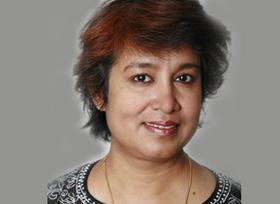
Mamata backing fundamentalists: Taslima

The exiled author Taslima Nasrin has accused West Bengal chief minister Mamata Banerjee of backing hardline Muslims instead of protecting writers.

She said the Left Front had driven her out of the country so that the minority votes went its way. "But did they eventually get the votes?" the controversial feminist author was quoted by Hindustan Times as saying.

"How much do I really matter in swaying a vote bank?"

Mamata's Trinamool Congress ended the world's longest-serving democratically elected communist government in elections in May last year but there has been no talk of Taslima's return.

Instead, a function to launch her latest book was cancelled and she now says she has become 'a victim of political convenience'.

"Both the (erstwhile) Left Front government and the one led by Mamata Banerjee prefer appeasing fundamentalists rather than protecting the writers," she was quoted as saying by the Hindustan Times on Saturday.

Taslima told Hindustan Times over the phone that though a few 'pro-change' intellectuals had earlier voiced Bring Back Taslima campaigns during the Left Front regime, now they are silent which is 'astonishing'.

She believes that the people who raised their voice to bring her back to the country have started disliking her but she said, "I don't understand why they did not raise their voices this time."

According to reports, her book 'Nirbashan' (The Exile) was scheduled to be launched at the Kolkata Book Fair on Wednesday. The event was cancelled after some minority community leaders met the police and expressed reservations against it. But the publisher, People's Book Society, released the book at its stall.

The latest instalment of Taslima's autobiography details the circumstances of her forced exile from Kolkata in November 2007 following threats from Islamic fundamentalists who were protesting her book 'Dwikhandito' (Divided).

Nirbashan was released in Ekushey Book Fair in Dhaka on Thursday. 'Dwikhondito' was banned in Kolkata while other autobiographies 'Amar Meye Bela', 'Utol Hawa', 'Dwikhondito' and 'Shey Shob Ondhokar' were banned in Bangladesh. Other than these, her novels 'Ka' and 'Lajja' are also banned in Bangladesh. 


Saturday, February 4, 2012

Bangladeshi dies of 'BSF torture'

A Bangladeshi cattle trader was allegedly tortured to death by Indian Border Security Force (BSF) near the Birampur border of the district early Friday. 

Phulbari-40 Battalion of Border Guard Bangladesh (BGB) confirmed the death yesterday morning. 

The deceased was identified as Saiful Islam, 25, son of Nabiul Mondal, of Chaturpur village in Birampur upazila. 

Saiful along with some other cattle traders crossed the Birampur border Thursday night, local people said. BSF men of Bhimpur camp caught him while others managed to escape. 

Quoting the cattle traders, who could return to Bangladesh, Nazrul Islam, elder brother of Saiful, said BSF men had tortured his brother with sharp weapons.
Villagers informed him of the killing, Nazrul added. 

The victim's family members informed local BGB of the matter Friday noon. 

In connection with the incident, BGB, Phulbari-40 Battalion held a flag meeting with BSF of Bhimpur camp Friday afternoon when BGB claimed the body, sources said. But BSF denied the incident of torture and killing.
BSF later informed Rajab Ali, company commander of BGB, Bhaigarh camp of Birampur, that they had recovered a body from Lalpur, about 2km inside India from Bangladesh border. 

Another flag meeting was held yesterday afternoon when SK Singh, company commander of BSF, Bhimpur camp said that on information BSF had gone to the spot, and following the recovery of the body they had sent it to Hili hospital for an autopsy. 

Yesterday at about 7:10pm, BSF handed over the body to BGB. 

Maj Tareque Iftekhar, acting commanding officer of Phulbari 40 Battalion confirmed the incident saying, "We have strongly protested the killing". 

In a similar incident on December 17 last year, BSF gunned down two Bangladeshi cattle traders on Daudpur border of the upazila. 

Malaysia to build the bridge

A senior Malaysia official said on Saturday Dhaka and Kuala Lumpur are all set to sign an agreement on Feb 21 to construct the Padma Bridge by a consortium of Malaysian companies.

"We did a due diligence for the past one month and finally, with the consent of prime minister Datuk Seri Najib Razak, we told the Bangladesh government we are ready to build the bridge," said Datuk Seri S. Samy Vellu, who met the Bangladesh prime minister in Dhaka on Tuesday.

"Bangladesh has seen our success in building bridges such as the first and second Penang Bridge. (Bangladeshi) prime minister Sheikh Hasina requested us to look at the proposed bridge," Samy Vellu, Malaysia's special envoy to India and South Asia, told official Bernama news agency.

He said the deal would put together a consortium of Malaysian construction companies to take up the RM 6.6 billion job.

Samy Vellu said several big names in the Malaysian construction industry as well as those that are known as government-linked companies (GLC) are expected to join the consortium. Their work, he said, would be monitored by the Prime Minister's Department through his office.

"The contractor has brought in a financier from Dubai. Serious negotiations are currently going on between them. The Malaysian and Bangladeshi governments have no say in identifying and deciding on the financier.

"This bridge will be a very important project for Malaysia as it will prove to the world that this country (Malaysia) has the ability to do anything on earth, especially in the infrastructure segment."

He said that a detailed timeline would be decided once the government-to-government agreement was sealed on Feb 21.

Bangladesh's biggest infrastructure project ran into trouble after one of the key lenders, The World Bank, raised questions about the bidding process for consultant supervisors.

The government rejected the Bank allegations, dared the Washington-based lender to prove the charges and threatened to find other sources to fund the ambitious project. 


Contents of Internet to be under scanner

Authorities have begun preliminary work on monitoring the content of blogs and social networking sites to track down and bring to task the perpetrators of cyber crimes under the 2001 Bangladesh Telecommuni-cations Act.(The Independent)

Giashuddin Ahmed, the vice-chairman of the Bangladesh Telecommuni-cations Regulatory Commission (BTRC), confirmed the new forward momentum on developing monitoring policies after Thursday’s maiden meeting of a 14-person panel to thwart cyber threats. The panel, named the Bangladesh Computer Security Incidents Response Team, was formed by the BTRC in response to an abortive military coup aimed at overthrowing Prime Minister Sheikh Hasina’s government in December.

The team will not only monitor contents of blogs and social media networks for potential threats, it will also oversee research on improving internet security systems and will advise law enforcement agencies in tracking potential offenders.

Under the Telecommunications Act, sending or publishing obscene messages, or harassment via phone or internet, telephone hacking, issuance of threat, publication of content that goes against the social values or incites hatred or attacks national unity and solidarity, are all among punishable cyber crimes.

Offenders, if proved guilty, will face a maximum punishment of five years' imprisonment and a maximum fine of Tk 300 crore.

More than a decade after the Telecommunications Act was ratified none of Bangladesh’s estimated six million internet users has been punished under it.

“We're trying to bring discipline to the sector, and that'll take time,” explained Ahmed. As of now, the team has yet to decide whether monitoring should be carried out on a random basis or through a systematic dredging of web content.

At Thursday’s meeting the panel, comprising of senior officials of the BTRC, representatives from internet service providers, mobile phone and cable operators, and others, was instructed to develop a concrete methodological proposal by Feb. 12.

The Bangladesh Internet Service Providers Association welcomed the government’s regulatory move, pointing out that the country has 85.45 million mobile phone users in addition to its estimated six million internet subscribers, making it one of the fastest growing internet using countries in the world.

Internet users are less enthusiastic, expressing concerns that innocent people may well be victimised by the policies and that government measures are too easily abused as a mechanism for infringing individual rights to privacy.

Neaz Rahman, an urban planner and project manager for the UN in Dhaka, however fears that the panel will become a tool for monitoring anti-government, rather than anti-state or actually criminal, activity.

A Dhaka resident, Mustafiz Alam, questioned the formation of the panel, without any representation for lay internet users, who would be more likely to raise questions about their own rights to privacy and free expression.