Pages

Thursday, March 8, 2012

Bhasani's call to divide Pakistan into two states


Moulana Abdul Hamid Khan Bhasani told a public meeting at Paltan Maidan in Dhaka on this day that East Pakistan/East Bengal would become an independent country soon. He demanded that President Yahya Khan divide the state of Pakistan officially into two independent states. 

As the momentum toward independence took gathered pace in the province, the Awami League modified some of the directives issued by Bangabandhu Sheikh Mujibur Rahman. An announcement to this effect was made by the party general secretary Tajuddin Ahmed. The entire province continued to be run under Mujib's directives. 

There was yet no move on the part of the Pakistan military regime to initiate negotiations with the Awami League in light of Bangabandhu's declaration of March 7. However, a series of meetings went on at army headquarters in Rawalpindi, the ostensible purpose of which was to find ways and means of tackling the popular movement in East Pakistan. It was obvious that the regime had been placed in a spot by Mujib's demand that power be transferred to the elected representatives of the people. 

Additionally, the fact that Mujib was in reality running the show in East Pakistan was a clear sign of how diluted the authority of the Pakistan government had become in the province. In effect, what alarmed the regime was that while the Bengali leader had not gone for independence for Bangladesh, he had made sure that the government of Pakistan be looked upon for the illegality that it was, especially against the background of its refusal to convene the national assembly or make a move toward a quick transfer of power to the majority party.

With each passing day, Bengali militancy went up by sure degrees. Nothing happened in East Pakistan unless it had the sanction of Bangabandhu Sheikh Mujibur Rahman. 


Fears of disruption as big solar storm set to hit Earth

A strong solar storm is expected to hit Earth shortly, and experts warn it could disrupt power grids, satellite navigation and plane routes.


The storm - the largest in five years - will unleash a torrent of charged particles between 06:00 GMT and 10:00 GMT, US weather specialists say.

They say it was triggered by a pair of massive solar flares earlier this week. 

It means there is a good chance of seeing the northern lights at lower latitudes, if the skies are clear.

The effects will be most intense in polar regions, and aircraft may be advised to change their routings to avoid these areas.

In the UK, the best chance to see them will be on Thursday night, the British Geological Survey says.

Complex network
 
"It's hitting us right in the nose," said Joseph Kunches, an expert at the US National Oceanic and Atmospheric Administration (Noaa).

He described the storm as the Sun's version of Super Tuesday - in a reference to the US Republican primaries and caucuses in 10 states.

"Space weather has gotten very interesting over the past 24 hours," Mr Kunches added.

The charged particles are expected to hit Earth at 4,000,000 mph (6,400,000 km/h), and Noaa predicts the storm will last until Friday morning. 

Images of the Sun's region where the flares happened show a complex network of sunspots indicating a large amount of stored magnetic energy. 

Other solar magnetic storms have been observed in recent decades. 

One huge solar flare in 1972 cut off long-distance telephone communication in the US state of Illinois.


Wednesday, March 7, 2012

Saudi diplomat’s killing puts Bangladesh in a tight spot

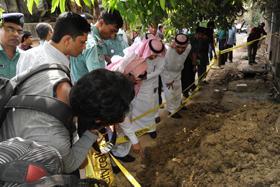
THE killing of a Saudi diplomat at Gulshan early Tuesday is more than a poignant pointer to dismal law and order situation in the capital Dhaka as elsewhere in the country; it has put Bangladesh in delicate position as regards its relations with Saudi Arabia. According to a report front-paged in New Age, Khalaf bin Mohammed Salem Ali, head of citizen affairs at the Saudi embassy in Dhaka, was found shot in his chest a few yards away from his residence at about 12:50am, rushed to a city hospital at about 1:15am and was declared dead at about 5:15am. The operation officer of the Gulshan police station quoted the security guard of the nearby Portuguese consulate as saying that ‘he heard a gunshot at around 1:00am Tuesday and immediately saw a white car speed away.’ The incident provides a chilling reminder of the dismal state of law and order. After all, the killing took place in a locality which is just a stone’s throw away from the diplomatic enclave where security is supposed to remain heightened round the clock, round the year.

Most importantly, the killing of the Saudi diplomat could have serious ramification with Bangladesh’s relations with Saudi Arabia, which has been strained for different reasons in recent times. Suffice it to say, manpower export to Saudi Arabia has already marked a significant decline and the global financial crisis and economic recession may not have been the only reason contributing to the decline. Bangladesh certainly cannot afford a further dip in manpower export to Saudi Arabia and thus in remittance earning — which, along with earnings from apparel export, props the economy — given the fact that all other economic indicators have not been quite auspicious in recent times. While, according to the Bangladesh ambassador in Riyadh, the Saudi deputy minister for protocol has assured the Bangladesh government that the incident would have no impact on the relations between the two countries, such assurance appears predicated on how Riyadh perceives Dhaka’s response to its request for a ‘full investigation’ into the killing, in the days to come.

As such, there is hardly any room for the technicalities as to whether Khalaf was a ‘diplomat’, as claimed by the Saudi embassy in Dhaka, or a ‘non-diplomatic staff’, according to the foreign ministry records. Just as the foreign ministry director said in an official statement Tuesday evening, ‘regardless of the status of Mr Ali’, the government needs to be ‘determined to bring the perpetrators of the killing at the earliest.’ The investigators, meanwhile, need to keep in mind that the killing may have regional and international dimension to it. It is a standard practice in murder investigation to determine the motive, i.e. who stands to benefit most from it. If the killing were to further strain Dhaka-Riyadh relations and result in Saudi Arabia suspending recruitment of Bangladeshi workers, India and Pakistan would surely be benefited. The investigators need to take this aspect into account.

Overall, there is also very little margin for error in the investigation and the case needs to be resolved — the sooner the better — because it is not just a question of ensuring justice but also protecting the already wobbly economy from yet more blows.


Bin Laden WAS NOT buried at sea, but flown to the U.S. for cremation at secret location, claims intelligence boss in leaked email

  • Emails purported to be obtained by hacker group Anonymous dispute White House version of terror leader's final resting place
  • Believed to be part of 2.7million emails obtained from intelligence analysis group Stratfor and shared with WikiLeaks
  • Stratfor calls hackers 'thieves' and says some emails may have been forged or altered
  • Revelations come as FBI arrests key members of hacking group LulzSec, an offshoot of Anonymous
The fate of Osama bin Laden's remains have been called into question after emails leaked from an intelligence analysis firm say the body of the terror leader was actually sent to the U.S. for cremation

According to the emails, the Al Qaeda boss was shot and killed during the famous Navy SEAL Team Six raid on his compound in Abbottabad, Pakistan, was transported back to the U.S. and cremated.

The emails were allegedly obtained by the hacker group Anonymous from Stratfor, an organisation dealing with analysis of intelligence and geopolitical analysis.
It's also known as the 'Shadow CIA'. 

Last week, Anonymous announced that it had gotten access to 2.7million of the firm’s confidential correspondences, and said they could provide 'the smoking gun for a number of crimes'.

The hackers said Stratfor, based in Austin, Texas, were 'clueless' when it came to database security.

After bin Laden was killed in the famous raid in Pakistan on May 2 2011, the Obama administration said his body was buried at sea off the USS Carl Vinson - in accordance with Islamic tradition.

But in a particular set of emails given to WikiLeaks, the firm’s vice president for intelligence, Fred Burton, says he doubts the official White House version of what happened to bin Laden's body.

Stratfor’s vice-president for intelligence, Fred Burton, says the body was 'bound for Dover, [Delaware] on [a] CIA plane' and 'onward to the Armed Forces Institute of Pathology in Bethesda [Maryland]'.

Burial: After bin Laden was killed, the Obama administration said his body was buried at sea off the USS Carl Vinson, pictured here, in accordance with Islamic tradition

The claims are sure to stoke conspiracy theorists, especially since the Armed Forces Institute of Pathology that Burton refers to closed its doors on September 15, 2011, four months after bin Laden's death.

In another email, Burton said: 'If body dumped at sea, which I doubt, the touch is very Adolph Eichman like. The Tribe did the same thing with the Nazi's ashes'.

'Eichmann was seen alive for many months on trial before being sentenced to death and executed. No one wanted a monument to him so they cremated him.'

Stratfor CEO George Friedman responded: ‘But i dont know anyone who claimed he wasnt eicjhman [sic]. No comparison with suddenly burying him at sea without any chance to view him which i doubt happened [sic]'. 


Final resting place? Leaked emails say Osama bin Laden's body was transported to the Armed Forces Institute of Pathology in Maryland,' which closed its doors on September 15, 2011

In a February 27 statement, Stratfor said: In December, thieves compromised Stratfor's data systems and stole a large number of company emails, along with other private information of Stratfor readers, subscribers and employees. Those stolen emails apparently will be published by Wikileaks. This is a deplorable, unfortunate - and illegal - breach of privacy.


On TV: Bin Laden is shown watching himself on television in this video frame grab released by the U.S. Pentagon May 7, 2011, six days after his death

'Some of the emails may be forged or altered to include inaccuracies; some may be authentic. We will not validate either. Nor will we explain the thinking that went into them.

Having had our property stolen, we will not be victimized twice by submitting to questioning about them.'

Stratfor, which is not affiliated with the U.S. government, would not comment further.

The emails were revealed as it was reported that a members of LulzSec an offshoot of Anonymous, were arrested by the FBI.

An agency official told Fox News that the arrests were 'devastating' blow to the organisation, saying: 'We’re chopping off the head of LulzSec.'

The 'Adolph Eichman' referred to by Burton was a Nazi lieutenant and a major architect of the Holocaust.


Viewing the raid: President Obama and his key staffers watch the Navy SEAL mission at Osama bin Laden's compound in this White House photo

After World War II ended in 1945, he was caught by U.S. forces, and he slipped through America's fingers when he gave them a phony name.

He wound up in Buenos Aires, Argentina, where he lived for years until he was captured by the Israeli spy agency the Mossad in 1960.

War crimes and crimes against humanity were among the charges he faced when he was found guilty in an Israeli court in 1962.

He was hanged, cremated, and his ashes were later spread over the Mediterranean Sea.


WHO IS ADOLPH EICHMANN?

Emails purportedly leaked from the intelligence analysis firm Stratfor make mention of Adolph Eichmann, a Nazi lieutenant and a major figure of World War II.

Eichmann, pictured above, is known as a major architect of the Holocaust. 

After World War II ended in 1945, he was caught by U.S. forces, and escaped custody after he gave them a phony name.

Eichmann fled to Italy, where he was able to obtain a humanitarian passport.
By 1950, he was in Buenos Aires, Argentina, where he lived for years until he was captured by the Israeli spy agency the Mossad in 1960.

War crimes and crimes against humanity were among the charges he faced when he was found guilty in an Israeli court in 1962.

He was hanged, cremated, and his ashes were spread over the Mediterranean Sea.

Breivik charged with terror attacks

Anders Behring Breivik, who confessed to killing 77 people and injuring 151 in Norway, has been formally charged with committing acts of terror. 


Defence lawyers went to his prison near the capital, Oslo, to present their client with the charges.
Prosecutors have indicated they consider Breivik mentally ill and will seek to have him committed to psychiatric care rather than jailed.

Breivik is expected to go on trial on 16 April.

He has been charged under a paragraph in Norway's anti-terror law that refers to violent acts intended to disrupt key government functions or spread fears in the population.

"The defendant has committed highly serious crimes of a dimension we have no previous experience with in our society in modern times," prosecutor Svein Holden told reporters in Oslo. 

'Delusional universe'
 
If convicted, Breivik faces a maximum penalty of 21 years in prison.

The prosecution said last week it was prepared to accept Breivik was criminally insane and therefore not responsible for his acts, and as such it might not call for a prison sentence.

However, it reserved the right to alter that view if new elements emerged about his mental health by the end of the trial.

"The way the case appears at the time the charges are being brought, there is no basis to request a regular prison penalty," state prosecutor Tor-Aksel Busch wrote in instructions to prosecutors handling the case.

"But it must be clear in the charge sheet that the prosecution reserves the right, during the trial, to request a prison punishment or containment lasting 21 years, based on the complete evidence shown to the court."
Medical experts have been divided over Breivik's state of mind. 

An analysis by court-appointed psychiatrists last year found that he was insane, on the basis of 13 interviews with the prisoner.

Their report said Breivik lived in his "own delusional universe where all his thoughts and acts are guided by his delusions". 

However, four psychiatrists who subsequently assessed Breivik disagreed with several of their court-appointed colleagues' conclusions. 

In findings revealed in January, they argued that Breivik was neither psychotic nor schizophrenic and said they did not think he needed drugs.

Twin attacks 
 
The attacks on 22 July last year were the worst act of violence Norway has seen since World War II, and have had a profound impact there.

Breivik disguised himself as a police officer to plant a car bomb that exploded close to government offices in Oslo, killing eight people.

Still in uniform, he then drove to the island of Utoeya, where a summer youth camp of Norway's governing Labour Party was being held.

In a shooting spree that lasted more than an hour, he killed 69 people - mostly teenagers.

Breivik has said his attacks were atrocious but necessary for his campaign to defend Europe against a Muslim invasion.